

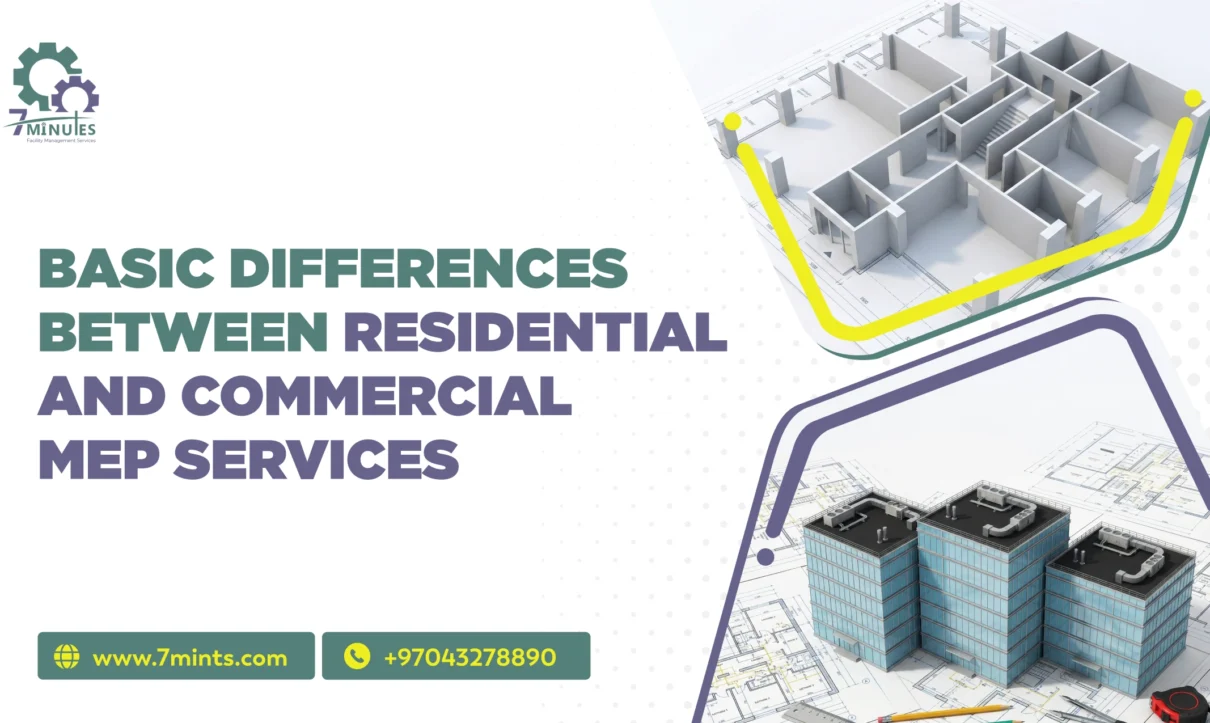
Mechanical, Electrical, and Plumbing (MEP) services are one of the most vital infrastructures of modern buildings. They make sure that a building can be used, is safe, and has the right conditions for the people inside. In a quiet house or a busy office, proper MEP systems play an important part in the daily running of the building.
But the MEP needs vary from building to building. Residential and commercial places have enormous differences in their scale, complexity, and usage. A clear perception of these distinctions is much needed by builders, property owners, and MEP contractors. This post will shed light on the different MEP services for residential and commercial buildings and their respective importance.
-
Scale and Complexity of the Systems
Residential MEP systems are mainly small and straightforward. These systems, with their lesser complexity, are easier to install, maintain, and manage, which ultimately makes them suitable for personal use.
In contrast to the above, commercial MEP systems are much larger and more complicated indeed. These are the systems running in the offices, malls, hospitals, hotels, and other places with a lot of people. Technologies that are used for MEP systems in commercial buildings have to deal with a lot of technical challenges, such as large areas with a lot of floors, elevators, large HVAC infrastructure, and industrial plumbing.
The commercial MEP systems are complex due to the wide range of functions. Though residential structures require only the basic utilities of electricity, water, and heating, commercial buildings have more extensive needs; for instance, one of the requirements is to have advanced fire safety systems, emergency backups, and super-specialized mechanical systems.
-
Design and Customization Requirements
MEP design for residential purposes takes into consideration comfort, beauty, and energy efficiency first and foremost. It is very accommodating in terms of the homeowner’s personal tastes, like the integration of the interior design, customizing lights, and HVAC for small spaces, etc. The ultimate aim is to offer the residents an easy and enjoyable living place.
On the other hand, commercial MEP design is primarily concerned with the functional and regulatory aspects. Building codes, security guidelines, and savings policies are some of the standards that systems must meet. Although residential buildings have different occupants each day, their design still has to consider scalability, standardization, and reliability of operations as the main points.
On the other hand, professional buildings involve the installation of complicated and big equipment like water chillers, industrial pumps, large generators, and intricate electrical wiring for IT and security systems. Consequently, the commercial MEP design takes a longer route through more elaborate project planning and advanced engineering calculations. The reverse is true for residential designs that are, though important, relatively simple and quick to execute.
-
Load and Energy Requirements
Residences are generally lower-heating and less thirsty buildings. The standard power loads, low water consumption, and relatively small HVAC systems are typical for the usage of homely comfort and a small number of people for everyday living.
In contrast, commercial buildings have very large-scale operations. A combination of a high number of people, office equipment, lifts, lighting, and always-on HVAC systems results in tremendous energy and water demands. Proper load planning is, therefore, necessary, and that involves the installation of high-capacity transformers and backup power solutions.
In homes, inverters or small generators may be enough for the backup systems. However, for commercial buildings, it’s a must that the power supply be done through the generators, UPS systems, and high-tech load management systems to ensure no downtime and proper safety of the operating area.
Energy efficiency is a more considerable problem in commercial MEP. The power consumption of large buildings is enormous, and thus, it is necessary to optimize systems for cost-effectiveness, sustainability, and regulatory compliance. Residential buildings are also concerned about energy use, but have much simpler operational issues.
-
Maintenance and Operational Complexity
Residential MEP systems require little maintenance, and this is usually the work of the homeowner or perhaps very small service providers. Daily activities such as dealing with leaks, changing light bulbs, or performing HVAC service are easy and cheap.
Commercial MEP systems call for the continuous presence of professionals as their scale and complexity require it. Such buildings usually comprise different interconnected systems whose maintenance is more difficult.
Preventive maintenance is very important in commercial environments. Scheduled inspections of HVAC systems, electrical panels, fire safety equipment, and plumbing pipelines are necessary to prevent downtimes, ensure safety, and keep the systems running efficiently.
The operating costs of commercial MEP systems are, in fact, higher. The presence of qualified technicians, usage of special tools, and constant monitoring all contribute to increased labor and operational costs. Maintenance of residential buildings continues to be affordable, with lower costs and less specialization needed.
5. Regulatory Compliance and Safety Standards
In comparison, however, these requirements are usually simpler and less rigorous than the ones for commercial buildings. Besides, compliance grants homeowners the minimum safety precautions and the convenience of a functional home.
Among these are fire safety codes, occupational safety regulations, environmental rules, and even, in some cases, industry-specific standards—depending on the type of building. Compliance is a must to eliminate the chances of legal penalties and disruptions in operations.
Under the commercial MEP, there is a high risk of severe effects in the form of fines, litigation, and shutting down of the operation if the compliance is not met. Non-compliance in residential buildings is still an important issue; however, the consequences are less severe, and the problem is often easier to solve. Check out our latest blog post on the Difference Between MEP Design and MEP Installation
To sum up
The comparison of residential and commercial MEP services shows the differences in the scale, design, energy demand, maintenance, and regulatory compliance, among others. Residential MEP is all about providing comfort, simplicity, and the preference of individual use, while commercial MEP offers large-scale buildings and efficient, safe, and reliable systems.
The differences between MEP residential and commercial buildings are very significant to the property owners, builders, and MEP contractors. Choosing the correct solutions makes sure that buildings are safe, efficient, and not very expensive. Contact us as the case may be, consult MEP service providers who are not only experienced but also reliable in terms of MEP solutions. They are well aware of the unique requirements of residential as well as commercial buildings.





1 Comment
Comments are closed.