

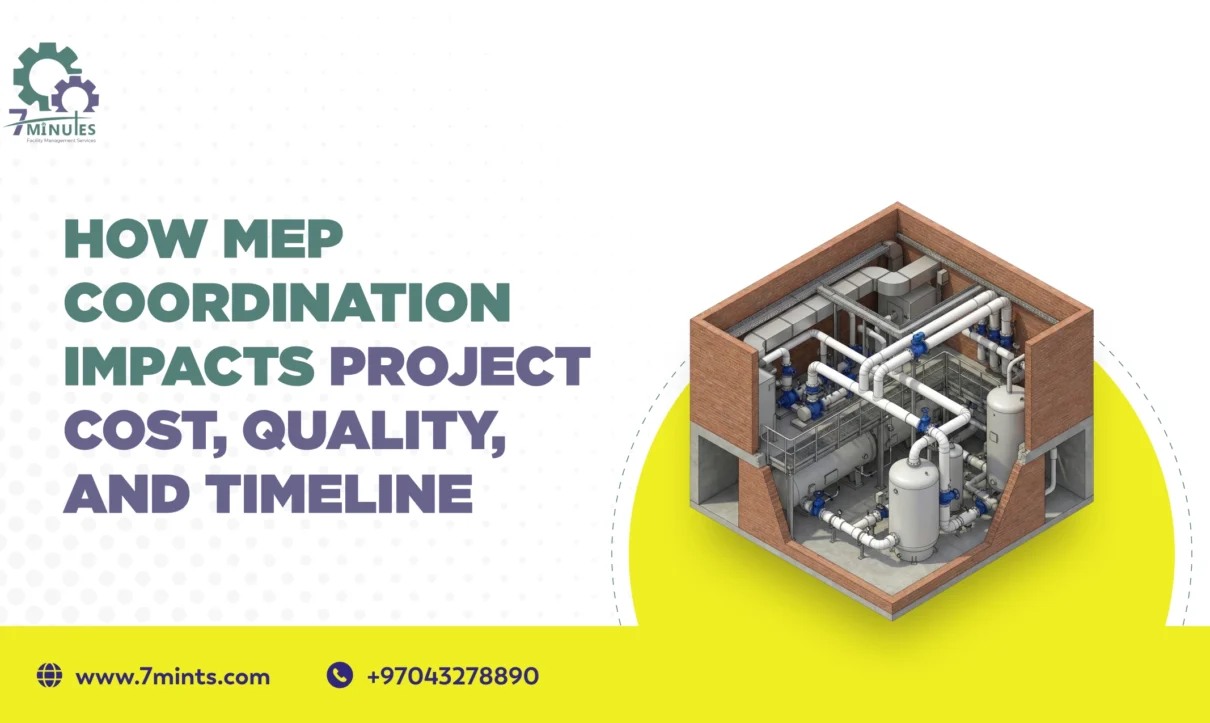
The construction industry has evolved with the use of MEP systems in buildings and their installations. At least the planning and execution of MEP systems have a big impact on the success of any project. These systems, if properly installed, will not only be the backbone of a building but will also provide comfort, safety, energy efficiency, and functionality.
It is almost impossible to have a building that does not rely on MEP. So keeping MEP installations in your project is a must to avoid clashes and delays. Instead, to come up with a better MEP installation, one will save time and money throughout the life cycle of the building. This blog post discusses how MEP coordination is a key factor in determining the project cost, quality, and duration. It also emphasizes the need for this coordination in modern construction.
What Is MEP Coordination?
MEP coordination refers to the process in which the mechanical, electrical, and plumbing systems are planned, aligned, and integrated within a building project. This means that the systems are allowed to fit into the designated space, and there is no interference among them or with the structure and architecture. The process begins with the design phase and continues throughout the lifetime of the project.
In actual MEP installations, the systems are forced to share almost the same tight spots, like the service corridors, ceilings, and shafts. MEP coordination serves to spot such problems and resolve them before they get to the construction site.
Good coordination can build on the development of detailed drawings, coordination meetings, and communication that is always open between engineers, architects, and contractors. When executed well, it produces a clear plan for further deliberation.
Key Components Involved in MEP Coordination
MEP coordination brings three main systems together, and every system has its own complexity. Mechanical systems incorporate heating, ventilation, and air conditioning (HVAC) along with their components such as air ducts, chillers, and more. Physical sizes for these parts are generally large, so they should be routed very carefully to avoid interference with the building structure.
Amongst the electrical systems, there are power distribution, lighting, emergency power circuits, fire alarms, and low-current systems like data and security ones. The electrical layouts have to be very closely aligned with the ceiling designs, wall finishes, and the locations of the equipment so that no last-minute switch is needed.
The plumbing systems include water supply, drainage, sewage, stormwater, and firefighting systems. These utilities typically operate by switching between vertical and horizontal routes through floors, which is very important because it establishes their location concurrently with structural and mechanical elements. Proper coordination invites installation without any trouble and also gives easy maintenance access.
How MEP Coordination Impacts Project Cost
Cutting down on the amount of work that needs to be done over again is one of the main outputs of good MEP coordination, financially. Rework is unavoidable whenever systems clash on-site, and therefore, the contractors have to take apart and then reinstall the components, which incurs more labor and material costs. To a large extent, early coordination can help in eliminating the most expensive mistakes at the beginning of construction.
Eliminating waste of materials is one more advantage MEP coordination brings about. When the drawings are coordinated and very clear, material is ordered in a precise manner, i.e., no extra purchases or quality, thus no additional storage costs. This builds up better control over the project budget.
Moreover, the delays caused by the poor coordination are often compounded by the contractors’ penalties, extended overhead costs, and the cash flow being interrupted. MEP coordination has become an essential part of project management, ensuring that costs do not spiral out of control and that no unplanned financial losses occur.
How MEP Coordination Improves Construction Quality
The construction quality is not only appraised with the help of its visual aspect but also its performance, safety, and durability. In fact, coordination between the different systems in the MEP field is one of the factors that contribute the most to the proper installation of the systems according to the design and technical specifications. The result of this is the optimal functioning of the systems and a longer service life.
Good coordination leads to tidy, accessible, and code-compliant installations. Maintenance access is properly planned, making future repairs easy and less costly. This, in turn, enhances the overall quality of the building.
On the contrary, poor coordination results in installations that are too tight, routing of unsafe services, and performance of the system being compromised. In contrast, MEP systems that are well coordinated bring about greater reliability in buildings and also make the level of comfort and safety for the occupants high.
How MEP Coordination Affects Project Timeline
One of the main causes of construction delays is the unanticipated clashes and last-minute design changes. MEP coordination deals with the problem directly by identifying these issues at an early stage; therefore, it eliminates the necessity of work stoppages and redesigns during the construction phase. As a result, the teams involved can follow the schedule more closely.
In the case of proper coordination, the sequencing of the work is made easier. It is possible to plan mechanical, electrical, and plumbing installations in the right order so as to avoid conflicts between the trades that are working in the same area. This leads to an increase in productivity on-site.
The inspection and approval processes also become faster if systems are well coordinated. The authorities and the consultants can review clear and accurate layouts, thus reducing delays that are caused by corrections and resubmissions. Check out our latest blog post on How Do Biopesticides Work to Protect Your Home and Garden?
Role of BIM in Effective MEP Coordination
Building Information Modeling (BIM) has practically revolutionized the whole MEP coordination process. The fantastic thing about the BIM is that it permits the modeling of all systems within a 3D environment, thereby facilitating the confrontation of the clashes at a point before construction starts. Thus, there is a great reduction in the on-site problems.
By means of BIM, the different teams can get a clear picture of the MEP systems and how they interact with the other structural and architectural components. This fosters the sharing of knowledge and coordination amongst the stakeholders; hence, great decision-making.
Besides that, BIM also assists in documenting, taking off quantities, and future management of the facilities. Projects that are built on the MEP coordination of BIM are more effective, exact, and less troublesome to control during the whole life span of the project.
The Most Common MEP Coordination Problems
The late engagement of MEP consultants is one such big issue in MEP coordination that has been facing the industry for several years already. If the coordination is done after the design is already settled, then the resolution of such conflicts becomes both hard and costly. Thus, the planning phase is the very first thing that needs to be done to prevent such an issue from arising at all.
And the lack of communication between the various disciplines is another problem that is often encountered to a great extent. When there are no regular coordination meetings and the corresponding data is not shared, misunderstandings can arise, which will in turn lead to execution errors.
Also, incomplete or non-up-to-date drawings are a source of confusion at the site. Whenever teams are working with wrong information, mistakes will definitely happen. Thus, proper documentation and control of versions are some of the practices that can be implemented to combat these problems.
Win-Win Practices in MEP Coordination
The early planning and engagement of all the parties involved are the very first steps toward successful MEP coordination. When the MEP engineers are brought in during the design phase, then the problems are solved as they arise, and at a cheaper cost.
The regular coordination meetings not only synchronize the teams but also help in the quick resolution of conflicts. Furthermore, the distinct roles, obligations, and communication paths will guarantee that everyone is working on the same objective.
Real-World Impact of Poor vs. Good MEP Coordination
Inefficiently done MEP coordination comes along with the suffering of the project in the form of constant delays, cost escalations, and poor quality. Issues that crop up during the construction process become the cause of the above problems, and eventually, the client loses trust in the company.
On the other hand, the projects with coordination of mechanical, electrical, and plumbing systems in place work much better and with more team spirit. Systems get installed right at the first go, which means saving both time and money.
The developers and the contractors who put their money in MEP mugging will be the ones to enjoy quicker project completion and better quality, which, in turn, will lead to greater client satisfaction. Thus, coordination ends up being a valuable investment that pays off in the long run.
Conclusion
MEP coordination might not be the most important factor in the success of a construction project, but it is nevertheless a very important one. The cost of the project is directly affected by it through the reduction in rework and wastage; installation done right improves quality, and timelines are kept since there are no delays.
In the present complex construction environment, MEP coordination could be neglected, but the drawbacks would be seriously adverse. Taking the route of proper planning, hiring of experts, and BIM-based MEP coordination may be slower initially but bring about long-lasting value and smooth project execution. Contact us as for developers, contractors, and project managers, strong MEP coordination is the way to go for delivering efficient, high-quality, and on-time construction projects.





1 Comment
Comments are closed.