

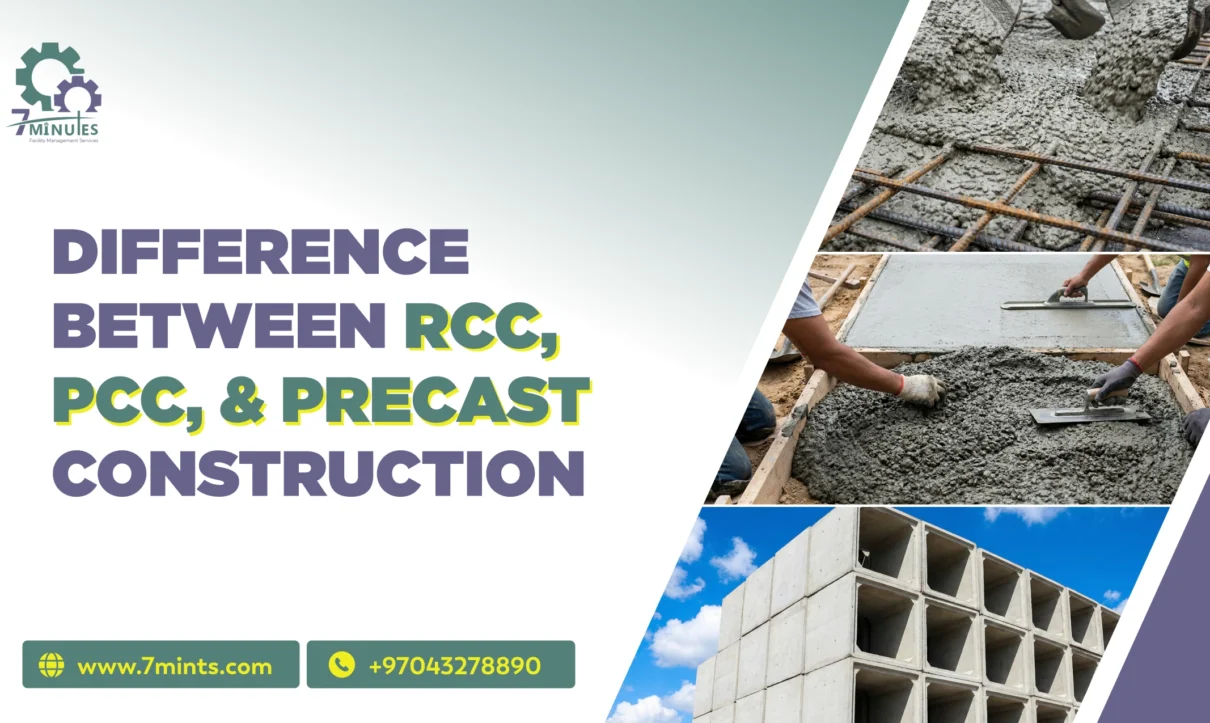
Concrete is one of the most widely used materials in the construction industry because of its strength, durability, and versatility. Different construction projects require different concrete systems depending on their structural requirements, budget, design, and construction timeline. Three commonly used methods are reinforced cement concrete (RCC), plain cement concrete (PCC), and precast concrete construction.
Understanding RCC vs PCC vs precast construction helps property owners, contractors, engineers, and developers select suitable methods for their projects. Although all three approaches use concrete, they differ in composition, manufacturing processes, structural applications, and installation methods.
In the UAE, where construction projects range from residential buildings to commercial developments and industrial facilities, selecting the appropriate concrete method can improve project efficiency, quality, and long-term performance.
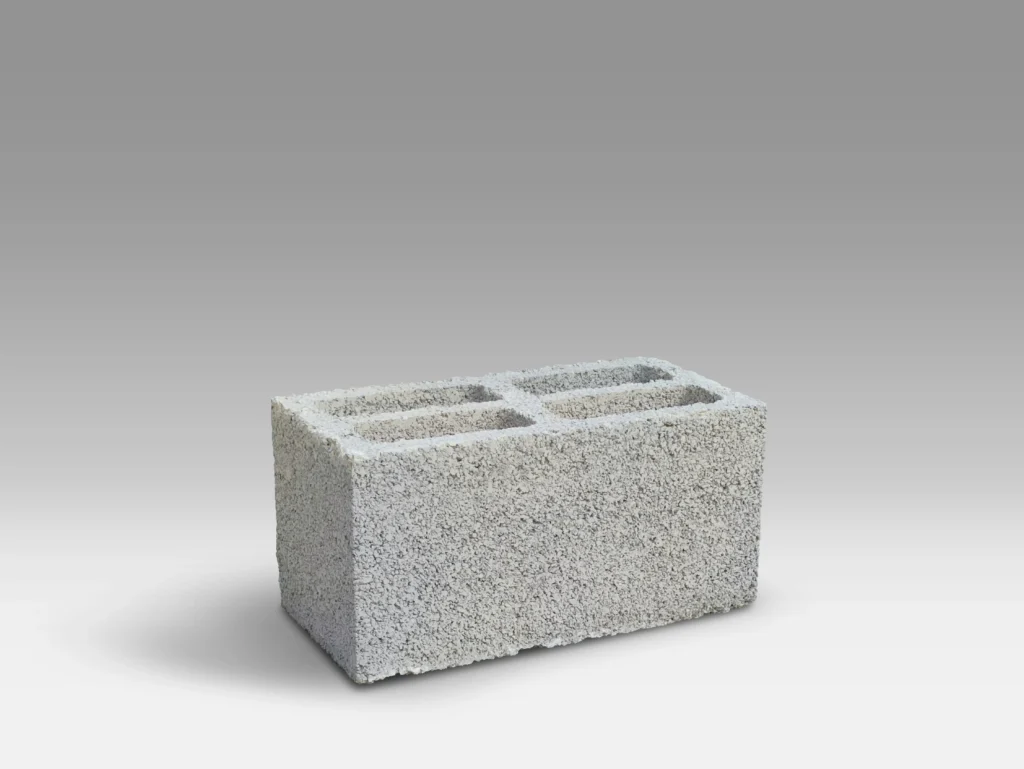
What Is RCC Construction?
RCC stands for reinforced cement concrete. It is a composite material made by combining concrete with steel reinforcement bars or mesh. Concrete performs well under compression, while steel reinforcement helps resist tensile forces. Together, these materials provide the strength required for many structural components.
RCC construction meaning refers to a construction method in which reinforced concrete is used to build structural elements such as columns, beams, slabs, foundations, retaining walls, and staircases.
RCC components are commonly cast on-site using formwork, although reinforced concrete elements can also be manufactured in factories.
Advantages of RCC Construction
The main advantages of RCC construction include:
- High structural strength: Reinforcement helps concrete resist tensile stresses and bending forces.
- Design flexibility: RCC can be moulded into different shapes and sizes.
- Durability: Properly designed and constructed RCC structures can provide long service lives.
- Fire resistance: Concrete generally offers good fire resistance when designed and detailed appropriately.
- Wide availability: Cement, aggregates, steel reinforcement, and construction expertise are widely available.
RCC is commonly used for residential buildings, commercial towers, parking structures, bridges, and industrial facilities.
What Is PCC Construction?
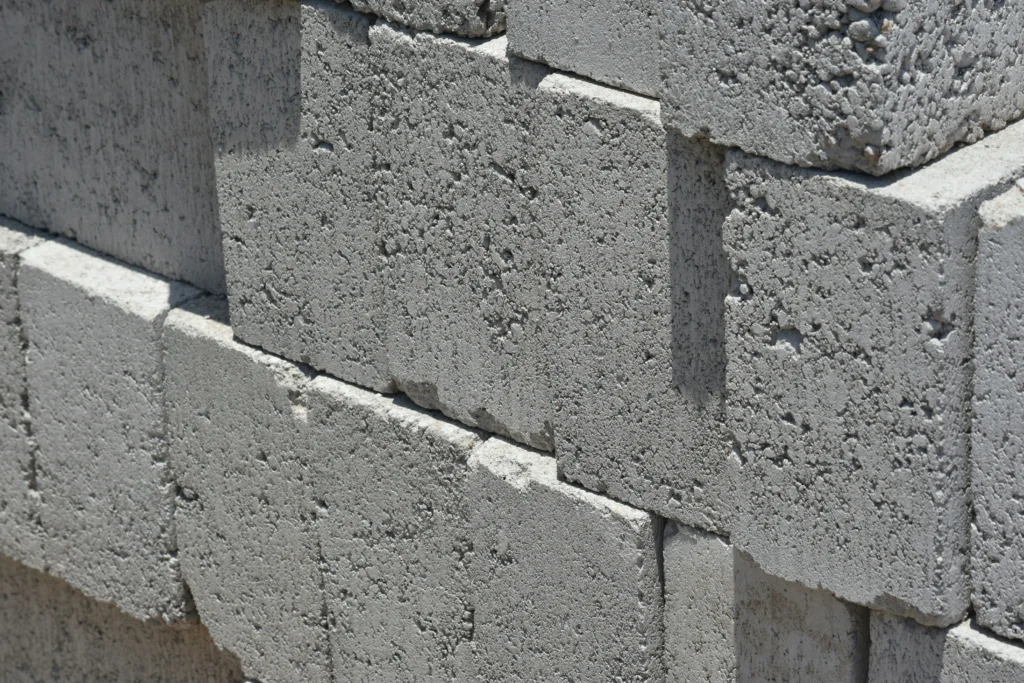
PCC stands for plain cement concrete. It is produced by mixing cement, water, and aggregates without the conventional steel reinforcement used in RCC.
The PCC construction meaning relates to concrete applications where reinforcement is generally unnecessary because the component does not need to resist significant tensile or bending forces. PCC provides a stable, level surface and can distribute loads over prepared ground.
Common PCC Concrete Applications
Typical PCC concrete applications include:
- Levelling courses beneath foundations
- Flooring base layers
- Blinding concrete below reinforced foundations
- Pathways and certain ground-supported surfaces
- Bedding or support layers for construction work
The suitability of PCC depends on the design, expected loading, ground conditions, and project specifications. It should not automatically be considered a substitute for reinforced structural concrete.
Benefits and Limitations of PCC
PCC is relatively simple to prepare and place. It can create a clean working surface, protect foundation reinforcement from direct contact with soil, and help contractors establish accurate levels before further construction.
However, plain concrete has limited tensile capacity. It is therefore generally unsuitable for structural elements that experience substantial bending or tensile stresses unless an appropriate engineering design provides another solution.
Also Read: Sustainable Construction Materials
What Is Precast Concrete Construction?
Precast concrete construction involves manufacturing concrete components in a controlled factory or casting facility before transporting them to the construction site for installation.
Unlike conventional cast-in-place concrete, which is poured and cured at its final location, precast components are produced separately and assembled on-site.
Precast Construction Methods
Common precast construction methods involve casting components in reusable moulds, curing them under controlled conditions, inspecting their quality, transporting them to the site, and installing them using suitable lifting equipment.
Typical precast elements include:
- Wall panels
- Floor and roof slabs
- Beams and columns
- Staircases
- Boundary walls
- Structural and architectural façade components
Modern precast concrete building systems can use reinforced concrete elements connected through engineered joints and connections. Their design must account for lifting, transportation, installation, structural loads, and long-term performance.
Also Read: Civil Engineers Ensure Buildings
Benefits of Precast Concrete
The main benefits of precast concrete include:
- Faster installation: Components can be manufactured while site preparation takes place.
- Consistent quality: Controlled production environments can improve dimensional accuracy and finishing.
- Reduced site work: Less formwork and concrete casting may be required on-site.
- Better scheduling: Repetitive components can be produced according to a planned production sequence.
- Reduced material waste: Reusable moulds and controlled production can help minimize waste.
However, precast construction requires transportation planning, lifting equipment, suitable site access, and carefully designed connections. These factors should be considered before selecting the method.
RCC vs PCC vs Precast Construction: Key Differences
The difference between RCC and PCC mainly concerns steel reinforcement and structural performance. The comparison between RCC and precast concrete, meanwhile, focuses largely on how concrete components are manufactured and installed.
| Feature | RCC | PCC | Precast Concrete |
|---|---|---|---|
| Full form | Reinforced cement concrete | Plain cement concrete | Concrete cast before site installation |
| Reinforcement | Usually includes steel reinforcement | Generally has no conventional reinforcement | May be reinforced or prestressed |
| Main purpose | Structural construction | Levelling and non-reinforced applications | Factory-made structural or non-structural components |
| Production | Often cast on-site | Usually cast on-site | Cast in a factory or casting yard |
| Installation | Formwork, reinforcement, pouring, and curing | Preparation, pouring, and curing | Transporting, lifting, positioning, and connecting |
| Typical applications | Beams, slabs, columns, and foundations | Blinding, levelling layers, and selected ground-supported work | Panels, slabs, beams, columns, and staircases |
Understanding RCC vs precast concrete requires recognizing that the terms describe different aspects of construction. RCC describes a reinforced concrete material system, while precast describes where and how a component is manufactured. A precast element can itself be made from reinforced concrete.
Similarly, PCC vs precast concrete is not a direct comparison between equivalent categories. PCC describes concrete without conventional steel reinforcement, whereas precast refers to a production method. Precast components may be reinforced or unreinforced, depending on their intended use and engineering design.
Which Construction Method Is Best for Your Project?

Choosing between these types of concrete construction depends on structural requirements, design complexity, project size, budget, available labour, and construction schedules.
RCC is suitable for many structural applications requiring strength under compression, bending, and tensile forces. PCC is appropriate for selected non-reinforced applications, including levelling layers and foundation blinding. Precast concrete can be advantageous when projects require repeatable components, controlled manufacturing, and faster on-site assembly.
For example, a building may use PCC beneath its foundations, RCC for its columns and beams, and precast concrete staircases or wall panels. These methods can work together rather than being mutually exclusive.
Developers planning concrete construction methods UAE should also consider site access, local climate, material specifications, project approvals, curing conditions, and the availability of specialist contractors.
RCC and PCC Applications in Dubai and the UAE
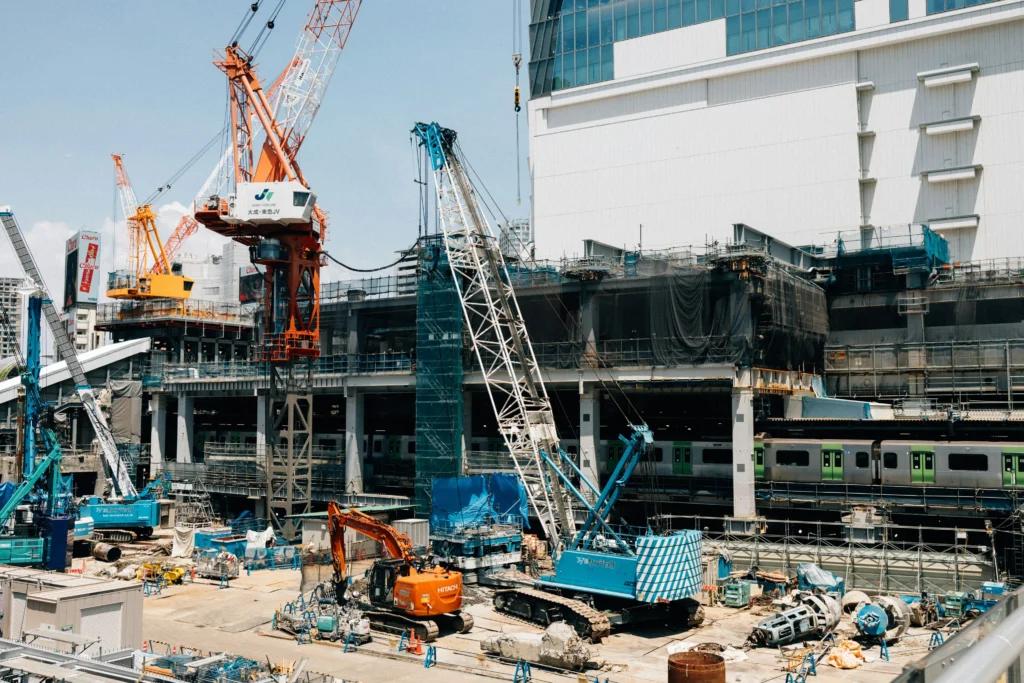
The RCC and PCC applications found in UAE construction projects vary according to building design and ground conditions. RCC is commonly used in structural frames, foundations, suspended slabs, and retaining structures. PCC may be specified for levelling layers and other non-reinforced concrete applications.
For RCC construction in Dubai, engineers must consider structural loads, durability, exposure conditions, concrete specifications, reinforcement detailing, and applicable local regulations. Proper workmanship and quality control are essential for achieving the required performance.
Meanwhile, precast concrete construction UAE projects can benefit from factory production when components are repetitive and site conditions support efficient installation. Precast elements may be particularly useful for residential developments, warehouses, commercial buildings, and infrastructure projects.
Companies looking for precast construction services Dubai should evaluate the supplier’s production capacity, quality-control procedures, engineering support, transportation arrangements, lifting plans, and installation experience.
Conclusion
A complete understanding of PCC, RCC, and Precast constructions is the first step towards the right decision for your project. Taking into account the strengths and the peculiarities of each method and when to use them can efficiently lead to your project being completed within the budget and with lasting results. Contact Us as Whether it is a small residential house, a large infrastructure project, or anything in between, the right construction method will always be the decisive factor in success.







1 Comment
Comments are closed.