Artificial Intelligence (AI) is playing a key role in advancing biopesticide development in the UAE. Machine learning technology enables AI to assist researchers in analyzing extensive data sets, which leads to faster biopesticide discovery, better formulation development, and improved real-world agricultural applications. The development process for biopesticides becomes faster and more effective because of this method, which delivers precise results that lead to improved agricultural production.
Data analysis helps scientists to speed up the process of discovering new biopesticides.
Researchers in traditional biopesticide research must manually sift through large microbial and genetic databases to identify useful organisms and compounds. Scientists use machine learning algorithms to analyze large datasets, which include genetic sequencing data, environmental data, and pest behavior data, to identify the best bio-pesticide candidates more quickly than conventional methods do.
AI technology enables researchers to create models that predict how pests will interact with different biological agents and assess the agents’ effectiveness. The process now requires less time and fewer resources because this method identifies optimal solutions through fewer testing cycles. AI technology enables researchers to make fast and accurate decisions, which accelerates the creation of new biopesticides while providing pest control solutions at an earlier time.
The system uses AI to recreate pest and biological agent interactions, which enables scientists to assess their effectiveness. The process simplifies solution selection because it eliminates the need for time-consuming laboratory experiments, which waste both time and resources. AI allows researchers to make fast, accurate decisions, which accelerates biopesticide development and results in quicker pest control methods.
-
Predicting Pest Outbreaks Using AI Models
AI-powered predictive models have changed pest outbreak management methods. AI uses historical pest data, climate data, and environmental data to predict pest population outbreaks at specific times and locations. This system allows farmers to implement biopesticides and other preventive measures before pests begin to infest their fields.
The AI systems can update their forecasts by using current weather information and actual ground soil measurements. The system advises farmers about upcoming threats, which will enable them to use biopesticides when climatic conditions show signs of pest population growth. The method helps farmers to manage their crops better, which results in decreased crop damage and higher agricultural output.
-
Improving Bio‑Pesticide Formulation with Machine Learning
The process of biopesticide development needs to begin after scientists identify a promising biopesticide candidate. The system uses AI to create optimal biopesticide formulas through its assessment of environmental variables, which include temperature, humidity, and soil types. Machine learning models can simulate how various bio-pesticides react in different environments, leading to the creation of more stable and effective products.
The extreme temperatures and arid conditions in the UAE make this situation important because it hinders the function of specific bio-pesticides. The researchers developed an AI-based system that enables them to adjust biopesticide formulations for maximum performance under multiple tough environmental situations. This system helps to extend the operational period of biopesticides while maintaining their effectiveness for outdoor use.
-
AI‑Powered Precision Agriculture and Bio‑Pesticide Application
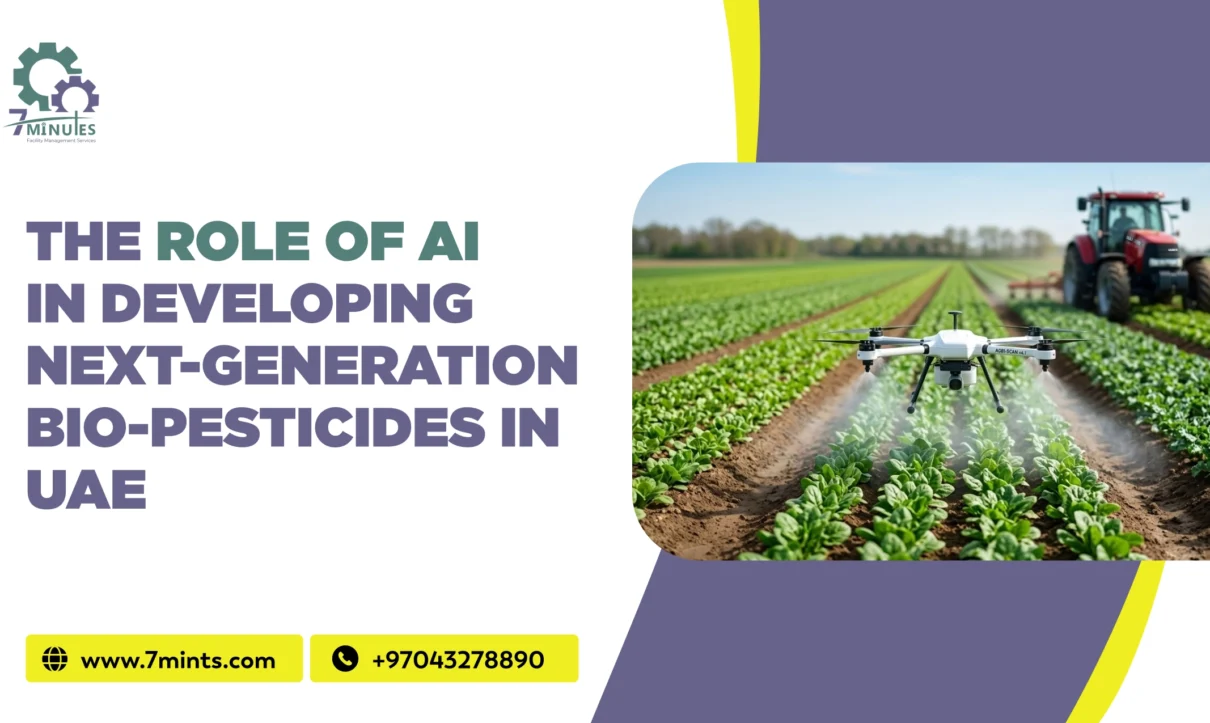
The use of AI technology creates a revolutionary change in how farmers use bio-pesticides for their agricultural work. Through drone technology, sensor systems, and robotic devices, farmers can use AI to achieve real-time field monitoring, which enables them to discover the initial indications of pest infestations.
Precision agriculture enables farmers to apply bio-pesticides only in required areas, which leads to reduced wastage and decreased environmental damage. This method achieves cost reduction while helping to create agricultural methods that are more environmentally friendly.
-
Strengthening Research Collaboration and Agricultural Innovation
The UAE government promotes AI agricultural technology development, which encourages research partnerships between public institutions, educational organizations, and private companies. The Mohamed bin Zayed University of Artificial Intelligence (MBZUAI) Institute leads AI research and agricultural research work to create new biopesticide discovery solutions through research partnerships. The research partnerships between organizations create an environment that supports scientific research activities.
The UAE government has established funding for agricultural research, which focuses on both AI development and robotics research to create local agricultural technologies. The UAE establishes itself as an international leader in agricultural solutions, which depend on AI technology, through its efforts to create sector-wide collaboration. The system needs this component to achieve its goal of effective pest control, which enables sustainable agricultural methods and productive farming techniques. Check out our latest blog post on Advances in Fermentation Technology for Bio-Pesticides
-
Supporting Sustainable Agriculture and Food Security
The UAE uses artificial intelligence technologies to establish its plan for achieving food security while maintaining sustainable agricultural practices. AI systems help farmers understand the specific needs of their crops, adjusting farming practices in real-time to ensure better resource management and higher yields.
AI-based biopesticides help sustainable agriculture through two methods, which include conserving resources and decreasing the negative effects that chemical pesticides produce on the environment. AI technology also helps control farming practices through its ability to determine the proper times for biopesticide application and the required amounts that must be used. The agricultural system will achieve its long-term goal of creating an environmentally sustainable and climate-resilient system through this process.
Conclusion
Artificial intelligence is a game-changer in the development of next-generation biopesticides in the UAE. AI technology accelerates the bio-pesticide discovery process while making formulation procedures better, and it provides scientists with better tools for precise pesticide application. Additionally, the United Arab Emirates can establish itself as an agricultural sustainability leader through its ongoing investment in artificial intelligence, which enables the development of environmentally safe and efficient biopesticides.
Agriculture will gain more advantages from AI technologies, which will become more common through future technological improvements. The use of AI in agriculture shows enormous future possibilities through the development of smarter bio-pesticides and better farming methods. Contact us as the agricultural system of the UAE moves toward a future that will become both more intelligent and more sustainable because AI technology functions as its primary development force.