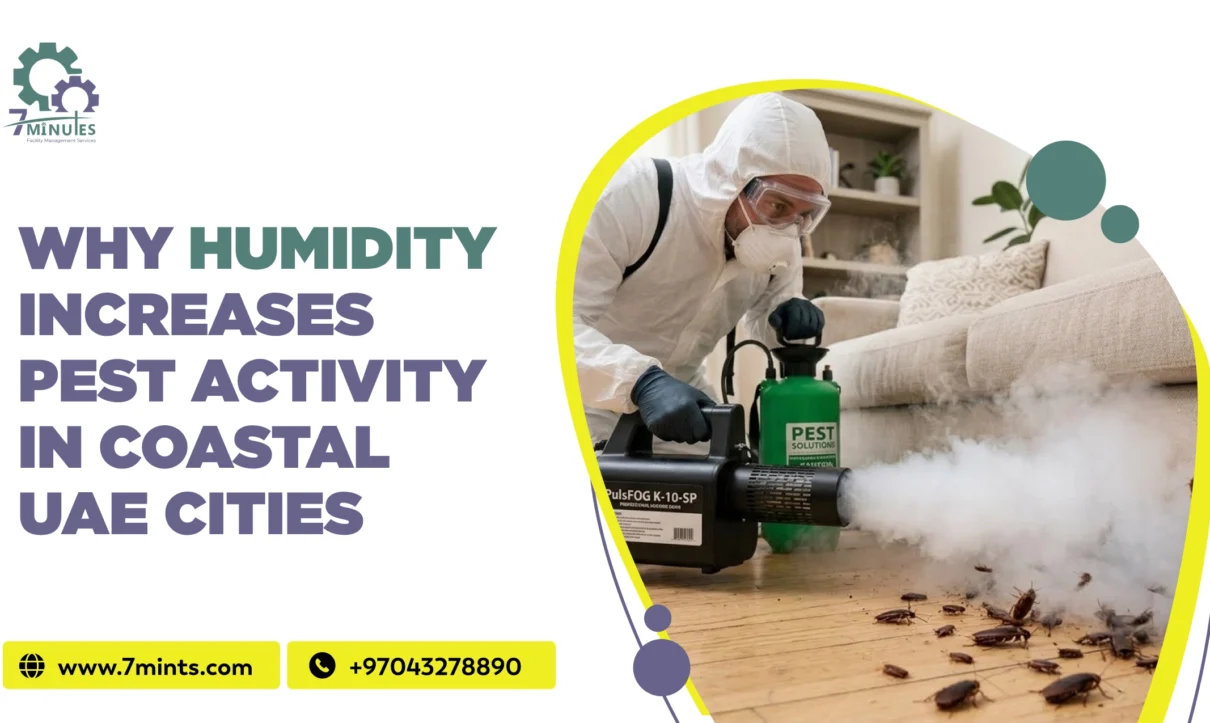
Dubai, Abu Dhabi, and other coastal cities in the United Arab Emirates face year-round high humidity because they are located near the ocean. The constant moisture in the atmosphere establishes conditions that enable pests to multiply without facing significant hindrances. Pests in humid conditions maintain their body moisture because they face less risk of losing water through dehydration. The cities experience regular pest problems, which affect both residential homes and commercial buildings.
-
Humidity creates ideal breeding conditions.
Humidity functions as an essential component for pests because it supplies the water needed for their breeding activities. The coastal cities of the UAE provide perfect breeding zones for cockroaches, mosquitoes, and flies because the atmosphere contains high humidity levels. Humidity enables pest eggs to maintain their required moisture levels, which improves their likelihood of survival and leads to faster hatching. An infestation begins to develop when pest numbers multiply rapidly, making it harder to handle throughout the progression of time.
Humidity affects pest life cycles by establishing consistent environmental conditions that enable their ongoing reproduction. Pests can reproduce in the kitchen, bathroom, and storage areas because these locations maintain damp conditions. These environments serve as secure spaces where pests can reproduce and develop their population without facing danger from outside sources. The continuous breeding pattern, which continues throughout time, eventually generates major pest problems that need professional pest control services for resolution.
-
Increased Availability of Water Sources
Pests depend on water for their survival needs because humidity brings them sufficient water resources throughout the day. Window, pipe, and wall surfaces in Sharjah cities develop condensation, which creates undetectable moisture problems. Pests can rely on this condensation instead of searching for open water, allowing them to stay active indoors. The combination of clean property maintenance and pest control efforts allows pests to thrive.
The presence of humid air creates conditions that decrease evaporation rates, which results in prolonged water retention on surfaces and inside small crevices. The extended period of moisture existence establishes multiple microhabitats, which allow pests to flourish without detection. Even tiny leaks or spills in high-humidity conditions create permanent water supply problems. Pest management becomes more difficult because moisture problems remain unsolved.
-
Faster Pest Life Cycles
Humidity accelerates the biological processes of many pests, leading to faster growth and reproduction. Pests in warm and moist environments reach maturity within their life cycles, which last only a few weeks. The ability of pests to reproduce multiple times within their reproductive cycle enables them to grow their population rapidly.
Pest infestations become more severe because pests complete their life cycles faster than humans can recognize them. A minor issue develops into an extensive infestation after three weeks when environmental conditions remain unchanged. The rapid pest population growth creates challenges for home and business owners because they depend on common pest control methods. The situation needs solutions through quick-response efforts combined with protective strategies to achieve successful results.
-
Increased Shelter Opportunities
The combination of high humidity and building material deterioration results in spaces that serve as excellent pest breeding locations. The presence of moisture in a building allows pests to enter through the openings created by deteriorating wood, walls, and ceilings. Coastal towns in the UAE experience these weather conditions because they face permanent humid air conditions. Termites, ants, and cockroaches find their preferred living conditions in environments that provide them with both water and hiding spaces.
Pests use these secret locations to hide from all forms of danger, which include heat plus pest control operations. The problem becomes worse because poor ventilation systems keep moisture trapped within building spaces. Through time, the wet environment, plus closed areas of buildings, develops into permanent areas where pests establish their nests. Check out our latest blog post on The Role of Waste Management in Controlling Pests
-
Attraction to Food and Organic Matter
Pests find food and organic waste more appealing to eat because humidity speeds up their decomposition process. The presence of moist conditions causes food particles to decompose at a faster rate, which creates intense odors that attract both insects and rodents. Pests in humid environments can find food through even tiny crumbs and spills. The increased presence of pests in kitchens, dining areas, and garbage storage areas creates higher infestation risks.
The improper handling of waste materials creates additional problems, which become particularly severe in coastal cities that experience high humidity. Pests use trash bins as breeding sites when the bins remain unwashed for an extended period. The combination of organic waste and moisture creates ideal conditions for the development of flies, cockroaches, and rodents. To stop pests from coming into our area, we must keep everything clean and dispose of waste material in the right way.
-
The Reduced Efficiency of Pest Control Methods
Many pest control methods and their associated chemicals lose effectiveness under conditions of high humidity. Pesticides become less efficient against pests when moisture causes their active ingredients to dilute or decompose. The treatment process allows certain pests to remain alive, which enables them to create new generations. Professional pest control services cannot stop infestations from returning because they treat all active infestations in one session.
Pests use humid environments as their recovery space because humidity grants them access to their preferred living environment. Pest control solutions will stop working after some time because they depend on eliminating excess moisture as their main problem. Humidity control should operate as a vital component of integrated pest management systems. The combination of chemical treatments with moisture reduction approaches establishes a system that prevents pests from returning.
Conclusion
The United Arab Emirates coastal cities experience higher pest populations because humidity conditions promote their breeding activities. The environment provides optimal conditions for insect reproduction while also providing insects with permanent access to water and accelerating their growth. Contact us as pests use food and waste products as their base resources, which causes permanent harm to structures. The high humidity levels create multiple factors that make it harder to control pest populations.
The best solution for dealing with pest infestations requires establishing two key components, which involve maintaining indoor humidity control and upholding proper sanitary standards. The system will achieve better air quality through improvements in ventilation, together with leak repairs and proper operations of the air conditioning system.