

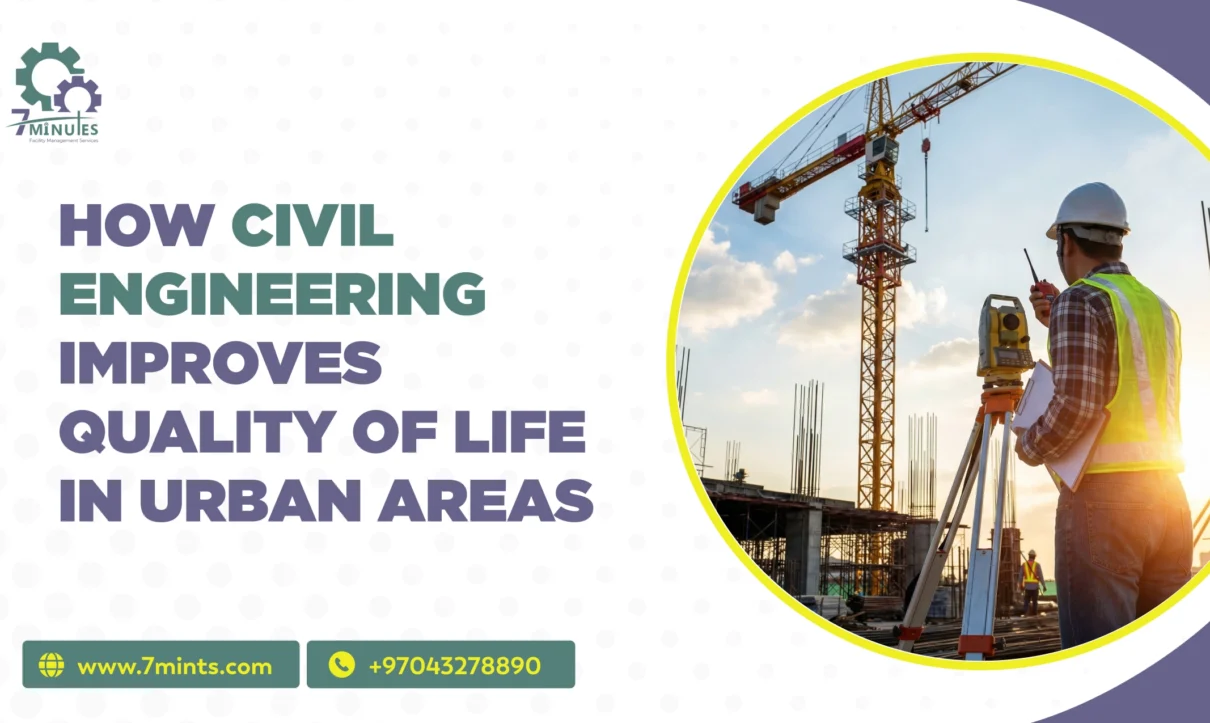
Urban centers are expanding at a fast pace, and along with the expansion comes the need to resolve issues such as congested roads, dirty air, crowded places, and an insufficiency of infrastructure. One of the main contributors to the resolution of such problems is civil engineering, which creates the modern cities of tomorrow with safety, intelligence, and sustainability at their core.
Civil engineers’ activities involve not only the construction of roads, water supply, and housing but also the disposal of waste, which eventually leads to the smooth and efficient functioning of the cities. The post tells you about the role of civil engineering in urban areas and how it enhances the lives of millions of people who are living there today.
Building a Robust and Secure Infrastructure
a) Reliable building and road design
Engineers in civil engineering create buildings, bridges, and roads that possess the qualities of being strong, stable, and safe for a long period of time. They abide by the strictest of engineering codes with the aim of ensuring the structures can cope with heavy weights, vibrations, and the daily wear and tear of use. This, in turn, diminishes the likelihood of accidents or the failure of structures that are located in crowded urban areas. Thus, people can go about their lives and travel with the assurance that the surroundings are indeed safe.
b) Earthquake- and disaster-resistant construction guaranteed
It is the case that many of the current big cities are built in areas that are either prone to earthquakes or floods. Hence, the demand for disaster-resistant structures is ever-present. Civil engineering gets rid of the possibility of earthquakes or floods doing damage to the built environment by employing cutting-edge materials and foundations that can absorb the impact and designing the buildings in such a way that they resist the forces of nature.
Besides, these actions not only save lives but also reduce the amount of money lost through destruction, thus accelerating the process of a city getting back to normal after a disaster. Building with consideration for future disasters is an uprising of the struggling urban community’s resilience.
c) Old infrastructure rehabilitation
A considerable part of the cities’ infrastructure is aged, obsolete, or has been damaged due to years of usage. Civil engineers carry out an analysis of the structures’ current state and either reinforce them or replace them with modern systems. This acts positively upon safety while also cutting down on the costs of repairs to the newly installed tech.
d) Creating long-term solutions
The durability of civil engineering works is an important factor to be considered when designing these projects. The use of quality materials and advanced construction methods is a practice that guarantees this durability. Hence, the maintenance cost is cut down, and the inconvenience caused by frequent repairs is avoided.
Waste will no longer be produced as a result of such long-lasting structures, and their environmental impact will be minimal in the long run. Majorly, such solutions continue to make life easier by maintaining stable and functional cities. check out our latest blog post on Solutions for Preventing Corrosion in Steel Reinforcement
Improving Transportation and Reducing Traffic
a) Efficient road networks
Civil engineers give us wide roads, flyovers, underpasses, and smart junctions, which all facilitate the smooth movement of traffic. As a result of these systems, the bottlenecks are eliminated, time is saved, and daily commuters’ frustration is reduced. Organized road networks also help in cutting down air pollution, as they do not allow long idling times. A journey that goes smoothly is a direct way in which productivity and living standards are improved.
b) Public transportation systems
Urban travel is made easier through the construction of metros, bus rapid transit (BRT) corridors, and dedicated bus lanes by civil engineers. These systems not only provide quick, economical, and dependable transport but also reduce the number of cars on the street. This, in turn, lessens traffic problems and enhances the quality of air in cities. Public transport networks benefit all the residents of cities, including low-income families, by making the cities kinder and more accessible.
c) Smart traffic management
The engineering team employs technology; it includes sensors, cameras, and AI to monitor traffic movement and adjust lights accordingly. It cuts back on the waiting time at the intersections, which leads to faster transportation. The advanced system can also spot accidents fast and redirect vehicles to other roads. The solutions that are based on technology make driving to work every day a less stressful experience.
d) Design for the pedestrian and cyclist users
The city infrastructure is in favor of pedestrians when it comes to footpaths, cycle lanes, crosswalks, overhead bridges, and skywalks, helping people move around in safety without needing to rely on cars. These amenities promote a healthier lifestyle and lead to less smoke and noise because of fewer people using motorized transport. Civil engineers design these spaces specifically for the purpose of minimizing accidents and maximizing safety for all. The cities that provide such amenities are the ones that welcome everyone and are less harmful to the environment.
Providing Clean Water and Sanitation Facilities as a Right
a) Water supply systems design
The designs of the civil engineers include the whole process of the construction of pipelines, treatment plants, and distribution networks, whereby the population is given clean drinking water in their houses.
In this way, people can have safe and reliable water access during the day. Proper water distribution is one of the measures that reduces diseases that are caused by contamination or poor storage. A solid water system is a must for the health of an urban population.
b) Waste Management
The modern sewage treatment plant works to get rid of the pollutants that are dangerous to human health and the environment from the wastewater before that treated water is poured back into nature. This, in turn, protects the rivers, lakes, and groundwater sources from being contaminated.
The civil engineer’s work comes to the fore again when they create underground sewage lines that are leak-proof and odor-free and also waterlogging-free in dense areas. Such systems are a big help in maintaining the cleanliness and health of the urban population.
c) Solutions for Rainwater Harvesting
The urban regions more often than not experience water shortages because of the high demand and the limited resources. Civil engineers install rainwater harvesting systems in buildings, public areas, and housing societies to store rainwater and collect it for the future.
The collected water can be used for gardening, cleaning, or even treated for drinking. This way, water coming from the municipal side will be less used, and the ecosystem will be better supported in the long run.
d) Stormwater Drainage
heavy rain and consequently flooding and other disaster occurrences. Urban planners and civil engineers would come together to devise the perfect drainage systems as a means of preventing such events. Engineers usually design stormwater drains, culverts, and underground pipelines as drainage systems.
The main objective of these systems is the quick removal of rainwater. The removal of excess rainwater avoids damage to cars, streets, and houses, and life progresses as usual even during heavy storms. Proper drainage is one of the significant contributors to the control of waterborne diseases.
Extending Urban Sustainability and Green Spots
a) Establishing parks and recreational grounds
Civil Engineers, along with urban planners, design the parks in which they make the gardens and the open spaces that have the ability to assure the best possible air quality and to give the public the most desired relaxation places. The green parts of the cities absorb to a great extent the stress coming from urban life and offer the residents a place to do fitness, meet, and have fun.
Moreover, the reduction of the “urban heat island” effect is one of the major advantages of this scenario because it lowers the maximum temperatures of the areas with high population density in the cities. To summarize, parks bring not only happiness but also wellness to the city dwellers.
b) Use of eco-friendly materials
Civil engineers are increasingly adopting recycled materials, low-carbon concrete, and energy-efficient designs as a means to mitigate the environmental impact. Such materials cause a reduction in the amount of building-related greenhouse gas emissions.
Thus, the practice of engineers using sustainable methods is already a part of the environmental and urban-oriented approach that nature conservation and development go hand in hand. The practice is in line with the global climate goals and responsible development.
c) Development of energy-efficient buildings
Civil engineers plan the construction of buildings that use the least possible energy by means of insulation, lighting, and ventilation. Such buildings make less use of air conditioners and lighting, which leads to a reduction in electricity bills for families.
Moreover, the energy-saving buildings are more livable, as they can maintain a constant temperature controlled by the users. Thus, they build a more sustainable urban lifestyle that is eco-friendly and less costly at the same time.
d) Backing climate-resilient development
Urban zones are prone to severe heat, flooding, and, more so, surface runoff caused by rising sea levels. Climate-savvy people, among others, already see the perks in making their cities resist the wrath of the changes in climate by investing in structures with flood resilience, such as shaded and heat-proof materials.
These and others are the municipalities’ ways of accommodating climate change while securing their inhabitants. A climate-resilient city is a place where the future of its population is not threatened.
Waste Management and Clean Cities
a) Solid waste collection systems
Civil engineers are the ones who are responsible for the creation of waste collection routes, bin placements, and the selection of the right type of vehicles that would ensure a timely and hygienic disposal of garbage. A good collection of waste leads to no overflowing of bins, no bad smells, and no health-related issues. Moreover, it keeps the streets clean and adds to the beauty of the city. The cleanliness of the surroundings is a direct contributor to the livability of urban areas.
b) Recycling facilities and processing plants
The engineers are those who establish waste material sorting, recycling, and processing plants, which inevitably become the requisite dedicated facilities. This not only lessens the waste going to landfills but also curtails waste habit potentials. On-site employed recyclers are the other benefit; they will access non-cash with tax credits of 20kc per employee. The cities that have no delay in recycling are also more user- and eco-friendly.
c) Sanitary landfill design
A well-designed landfill is one that does not allow the toxic waste to seep through the soil or the water sources. To ensure environmental protection, the engineers have built the liners, drainage systems, and gas-collection units around the dumpsite. These actions not only lessen the impact on the environment but also create a shield for the communities nearby. Well-managed landfills play a vital role in waste management for a long period of time.
d) Smart waste bins
Modern garbage cans are equipped with sensors that notify the authorities when they are full. This stops the sight of overflowing waste and also minimizes the need for manual checks. Engineers have these bins incorporated into the smart city system for better surveillance and quicker action. Innovations like these make waste management seamless and more effective.
Advancement of Urban Housing and Income
a) Low-cost housing project
Civil engineers are the ones behind the design of affordable housing projects, which ensure the availability of safe and comfortable houses to low and middle-income families. Such housing schemes not only help to control urban slum areas, but they also raise the quality of living. The cost-efficient techniques and materials are the ones that allow the engineers to make housing available to everyone. The creation of affordable housing leads to the formation of stronger and more stable communities.
b) Upward city growth
The engineers build high-rise structures that can accommodate more people in a limited area as the land becomes limited in developed cities. These skyscrapers are equipped with various safety measures like elevators, fire escapes, and robust foundations. The growth of the city vertically helps the city to develop without getting too far away. This method helps in conserving the land and cutting down on commuting time.
c) Building with safe foundations
Engineers analyze the ground, bringing about the case of the foundation, and construct foundations that keep the buildings even at the production of a crowded city. A high-quality foundation not just protects against cracking, displacement, and even falling but also makes the building stable. The masses that reside in those buildings can rest in peace in the midst of earthquakes and heavy winds since engineers have already ensured it through safe structural design. Public access to safety in terms of living and working environments has been created in this way.
d) Community-centred urban planning
Civil engineers develop up to two schemes for city planning. One is where the neighborhoods are provided with all the essential services, such as schools, hospitals, parks, markets, and transport; it makes living in the neighborhood very much easier by reducing the traveling time. In addition, good neighborhoods keep people connected and promote an active, healthier lifestyle. The people living in the various neighborhoods of a city will never feel neglected due to balanced development.
Boosting Economic Growth and Opportunities
a) Quality infrastructure attracts companies.
The presence of good roads, public utilities, airports, and telecommunication networks are the major factors that lead cities to be the most wanted locations for both companies and investors. Civil engineers play a major role in providing the backbone that sustains business activities and, consequently, economic growth. As the businesses grow, they in turn create more job opportunities, which lead to a daily increment of the local economy. An infrastructure development plan, in the long run, will be a direct way to raise people’s standard of living.
b) More jobs
Hiring for civil engineering projects typically involves workers, technicians, architects, designers, and the like in many different areas. From construction to maintenance, these jobs are sustaining the livelihoods of thousands of families. Besides, the larger infrastructure projects also provide longer-lasting economic benefits. The job openings created by infrastructure projects are instrumental in knocking down poverty levels and enhancing the well-being of the community.
c) Improved logistics
The best-designed transport networks create a quick and uncomplicated flow of goods from one point of the city to another. This means that delays are being cut down and the transport costs for businesses are being reduced. Good logistics make food, medicines, and daily necessities delivered faster. Consequently, the quality of urban life becomes smoother and more reliable.
d) Higher property values
Property values go up when areas are well-constructed, have good roads, parks, and clean surroundings, and the utilities are reliable. This situation makes real estate more appealing to both buyers and investors. A rise in property value also brings about an increase in the wealth of the existing homeowners. Civil engineering indirectly contributes to the financial growth of urban inhabitants.
Conclusion
Civil engineering is one of the major factors that influence the development of modern cities and the improvement of human lifestyles. The engineers have been there from the beginning of construction, from safe buildings and better roads to providing clean water, efficient waste disposal, and a sustainable living environment.
Thanks to civil engineering, urban areas will be made more orderly, productive, and livable than they already are. The more advanced the technology becomes, Contact us as the more civil engineers will be working in the direction of developing smarter and greener cities that support people in living better lives.




1 Comment
Comments are closed.