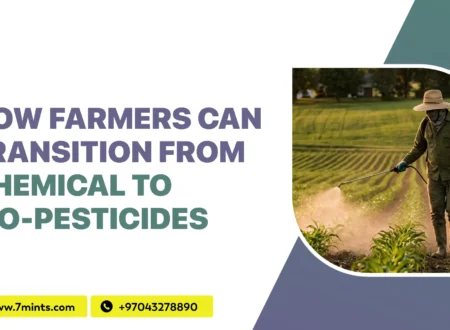
Agriculture has experienced a major transformation during the last few years. Chemical pesticides create lasting health and soil and environmental effects, which farmers, governments, and consumers now understand. Biopesticides have developed into a sustainable solution that provides economic advantages after this discovery.
Biopesticides originate from natural substances, which include plant materials, bacterial strains, fungal organisms, and specific mineral compounds. The product provides environmental benefits because it selects particular pests while safeguarding helpful organisms from damage. The agricultural industry finds a business opportunity with this scientific development, which has gained substantial market demand.
Understanding Bio-Pesticides: The Science Behind Them
Biopesticides use natural substances and biological organisms to create agents that control pest populations. Microbial biopesticides employ Bacillus thuringiensis (Bt) bacteria to target dangerous insect species while keeping crops safe. The research maintains scientific accuracy because it decreases environmental impact on soil conditions and non-target organisms.
Biopesticides include three major groups, which are microbial pesticides and plant-incorporated protectants and biochemical pesticides. All three groups maintain different operational methods while they utilize natural methods to manage pest populations. The scientific research verifies biopesticides as trustworthy solutions for sustainable farming practices.
Biopesticides offer environmental cost advantages because of their biodegradable nature and lower environmental impact. The scientific advantage produces economic benefits through its reduction of soil degradation and water pollution costs. Healthy soil conditions will boost agricultural production, which results in higher profits for farmers.
Rising Market Demand for Safer Food
People worldwide show growing interest in food products that contain no chemical substances and organic ingredients. The organic food market in the United States, India, and Germany continues to experience ongoing growth.
Consumers show increased interest in organic produce when social media and food labels create greater awareness about organic farming practices. Farmers achieve better investment returns when consumers choose to pay more for organic produce. Thus, market demand is becoming a strong economic driver.
Cost Comparison: Biopesticides vs. Chemical Pesticides
Bio-pesticides seem more expensive than traditional chemical pesticides when viewed at their initial cost. The production costs and research investments, together with the short product shelf life, create higher price points. The extended financial forecasts reveal different outcomes from the current economic situation.
Farmers must apply larger amounts of chemical substances due to the development of pest resistance against chemical pesticides. Every season, this process results in rising input expenses. Biopesticides use multiple biological pathways to function, which makes it difficult for resistance to develop.
Government Policies and Subsidies
The government is working to advance sustainable agriculture practices because it wants to safeguard public health and environmental resources. The Indian government provides programs that support organic agriculture via natural farming methods, which help farmers adopt bio-pesticides. The policies establish financial protection during the period when transitions occur.
The US regulatory bodies have created easier registration processes for specific biological products. The system provides faster product approvals, which enable businesses to develop new products and attract funding for their bio-pesticide operations. The combination of subsidies and tax incentives and research grants creates financial relief for both manufacturers and farmers. Government assistance helps to strengthen the supply chain while enabling bio-pesticides to compete against major chemical companies.
Investment and Industry Growth
The global biopesticide market has been drawing more funds from agritech businesses and venture capital investors. The large agricultural companies are growing their biological product sections to provide solutions that match current market requirements. The market shows that sustainable solutions achieve long-term profitability according to market analysis.
Startups are developing new product formulas while they create better product protection methods. The combination of biotechnology progress and microbial research developments leads to lower production expenses. The advancement of technology will create better production methods, which enable biopesticides to become less expensive through increased production volumes.
Farmers need pest control methods that both withstand climate change impacts and protect the environment. Investors see bio-pesticides as an environmentally friendly solution that generates profitable business ventures.
Challenges in Market Expansion
Biopesticides show great potential, but they encounter specific economic problems that hinder their development. The adoption of new methods will be delayed because small farmers do not understand the technology. Farmers use chemical pesticides for instant results, which makes them hesitant to test unfamiliar products.
Many rural areas still lack biopesticide distribution networks. The need for storage space, together with the requirement for shorter shelf life, creates multiple logistical challenges. The two factors together increase operational expenses while making products harder to obtain.
The combination of educational campaigns, together with extension services and enhanced supply chains, will gradually succeed in overcoming these challenges. Adoption rates will increase through improved awareness and technological progress.
The Future Outlook: Science and Economics in Harmony
Sustainable agriculture requires scientists to find solutions that maintain agricultural productivity. Biopesticides represent a perfect example of science meeting market demand. Contact us as their biological precision reduces environmental harm while creating new economic opportunities.
The rising demand for environmentally friendly solutions, together with increasing regulatory requirements, will boost their economic value. Agricultural economies become robust through consumer demand, which drives science-based advancements.