

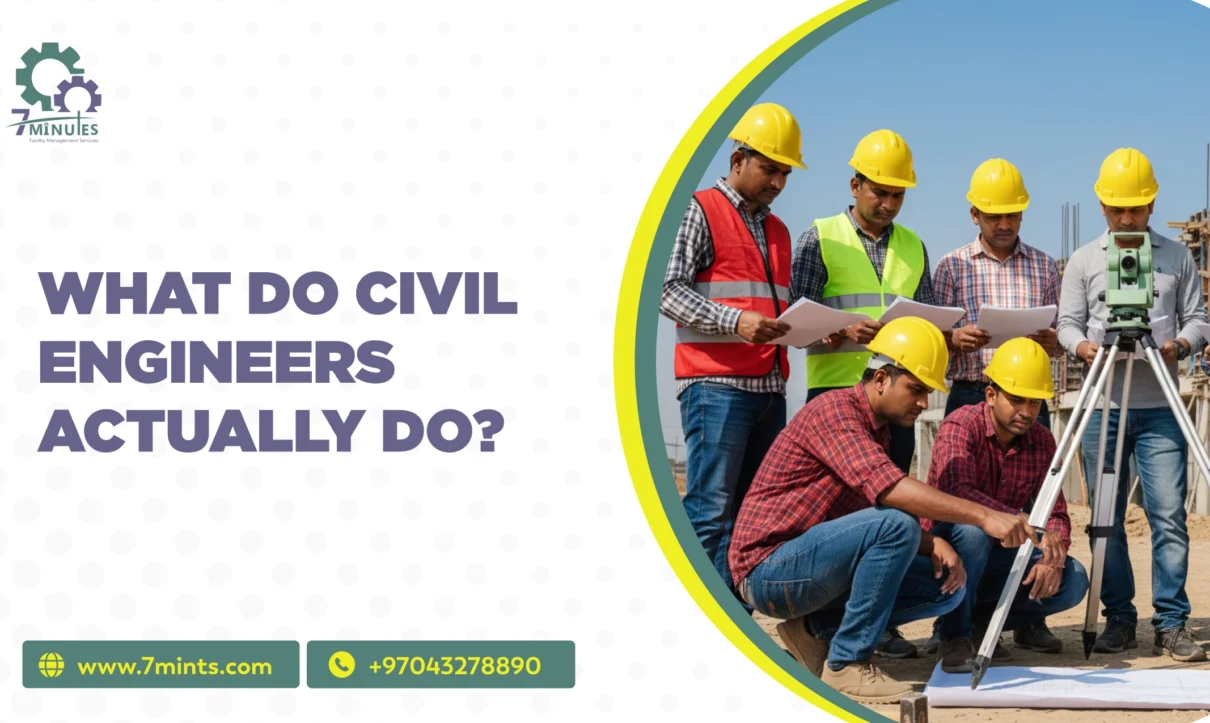
Civil engineers are among the most crucial people in our civilization and in the development of the world. Without the civil engineer, there would be no safe roads, bridges, and buildings that we can even talk about. Their work directly affects people’s lives, which in turn affects the growth of cities and the development of a nation. We will discuss the role of civil engineers, their contribution to the city infrastructure, and the limitations of their profession in this blog.
Planning and Designing Infrastructure
Civil engineers begin their work long before a construction project starts on the site. They map out and make designs in detail to turn an idea into a real building. This covers material selection, foundation, walls, etc. They adopt modern methods like AutoCAD, BIM, and 3D modeling software to produce designs that are both precise and safe.
Managing Construction Sites
After the planning phase is completed, civil engineers proceed to the construction site, where they not only take part but also supervise the daily operations. They direct the workers, the contractors, and the machine operators with the intent to ensure that the work is being done according to the design.
If any problem comes up in the course of construction, like a lack of material or problems with the site, civil engineers act to solve such problems immediately. They also make sure that the site is safe for all workers. Their great management skills play a key role in keeping the project within the planned time.
Ensuring Safety and Quality Control
Civil engineers are the professionals who check the materials they use, such as concrete, steel, bricks, and soil, for quality so that they all conform to safety standards. By conducting testing such as slump tests, concrete cube tests, and soil compaction tests, engineers are able to detect and eliminate future structural problems.
Also, they have to make sure that their construction is done according to the building codes and safety regulations, which in turn will avoid accidents, cracks, and failures in the long run. Control of quality is one of their major responsibilities.
Working With Maps, Surveys, and Soil Reports
Civil engineers conduct an in-depth study of land conditions before the construction of any building. They rely on maps, land surveys, and soil reports to get information about the terrain, levels, and subsoil conditions. Apart from these, GPS, total stations, drones, and laser scanners are the other devices that allow them to gather precise data. The type of foundation necessary for the structure depends on this information.
Managing Project Budgets and Timelines
Civil engineers have the responsibility of managing the financial aspect of the project as well. They draw up the budgets of all materials, labor, machinery, and equipment needed. Their strategy is to prevent the occurrence of further delays and unnecessary costs. Besides, they keep the communication going regularly with clients, contractors, and government authorities to inform everyone about the latest happenings. This keeps the project operating without any problems from the very beginning to the very end.
Handling Environmental and Sustainability Concerns
To put it simply, civil engineers are the ones who take good care of our planet. They conduct the environmental impact assessment and put together a plan that limits the amount of pollution, noise, or waste.
Additionally, they pick materials that are less harmful to the ecosystem and encourage energy savings in the client’s building. A variety of green features have been incorporated into modern constructions, such as solar panels, rainwater harvesting, and waste-management and recycling systems—all courtesy of civil engineers. Their commitment to nature has a positive impact on the world.
Specializations in Civil Engineering
Civil engineering is a wide discipline that comprises many different branches.
The following are some of the most notable areas of specialization:
-
Structural Engineering
The first thing the engineers will do is to calculate the maximum amount of weight that the structure can endure and the wind, vibration, or pressure that it will face during its life. They then proceed to select the appropriate materials and shapes that will hold the structure safe and stable. The very foundations of their works are the guarantees that the buildings will not crumble due to earthquakes, heavy loads, or extreme weather. Check out our latest blog post on The Future of BIM: Integrating AI and Digital Twins.
-
Transportation Engineering
The transportation engineers’ task is to develop systems making it easier for people and goods to travel, roads, highways, airports, and railway networks being their targets. They monitor and analyze traffic flow, accident-prone areas, and congestion patterns to map out safer routes.
The outcome of their planning is a reduction in travel time, improvement of road safety, and enhancement of economic growth. They create durable transportation systems that are capable of adapting to the demands of the increasing population.
-
Water Resource Engineering
Water resource engineers are the professionals responsible for managing the whole water cycle, including storage, supply, and control, in both city and countryside areas.
Their work involves the construction of dams, canals, pipelines, drainage systems, and rainwater harvesting structures. Besides this, they are also the ones who thwart floods, waterlogging, and the like in communities through the use of smart planning.
-
Geotechnical Engineering
Geotechnical engineers are the ones who examine the soil, rocks, and underground layers before the actual construction begins. They carry out tests to find out if the ground is strong enough to take the weight of a building or a bridge. After this investigation, engineers will decide whether to use shallow foundations, deep foundations, or soil improvement techniques. Their expertise enables the prevention of structural failures like cracks, tilting, land sinking, or landslides
-
Environmental Engineering
Environmental engineers are the ones who mainly protect the environment and enhance public health through scientific design. Industrialized nations have to invest heavily in modern wastewater treatment plants, air pollution control systems, and landfills, and this is where the environmental engineer’s work comes in.
They ensure that industries comply with environmental regulations and do not engage in practices that harm the environment. In addition, they support waste recycling, renewable energy, and pollution control, which in turn makes cities greener and more sustainable.
-
Construction Management
Construction managers are the construction professionals who take the entire building process under their control, that is, from clearing the ground to making the final finishing touch. They supervise the workers, materials, equipment, and project timelines to keep the whole thing going without any bumps. Besides that, they have to deal with daily construction site problems and liaise with engineers, architects, and subcontractors.
-
Urban & Infrastructure Planning
Urban planners are responsible for making cities that are not only great to live in but also safe, functional, and capable of future growth. The city layout is made up of roads, residential areas, and types of drains, as well as places for greenery and public activities.
Their plans solve the issues of overcrowded areas, streets with low or no traffic, or disorganized drainage by implementing zoning and proper utility systems. As a result, the urban designers become the heroes in terms of making a better living for the whole community.
-
The Use of Technology and Modern Tools
Civil engineering has reached new heights, and the city-building process is now fully supported by modern technology. To create 3D digital models of the construction sites, engineers use Building Information Modeling (BIM) software, for example.
Drones are also employed in the surveying process, whilst sensors continuously monitor the construction site, and AI helps in determining the risks associated with the project. The combination of these tools leads to more precise results, fewer human errors, and time-saving. In fact, technology has made civil engineering more rapid, smarter, and more efficient compared to conventional methods.
-
Preserving Current Infrastructure
Moreover, civil engineers not only create new buildings but also take care of the existing ones. They conduct inspections on a regular basis for bridges, roads, flyovers, and pipelines for checking cracks, corrosion, or damage. The main purpose of maintenance is to keep the structures safe and usable for a long time.
Engineers plan the work of repair, renovation, and strengthening to prolong the life of the old buildings and public facilities. This is a preventive measure against accidents as well as being economical in terms of cost incurred in reconstruction, which is in millions of rupees.
-
The Role of Civil Engineers in Nation-Building
Civil engineers are the keystone of every nation’s progress. They are the ones who build the infrastructure that makes life better for people—from roads and railways to hospitals, schools, and airports.
The work they do is always on the side of economic growth, not only through improved connectivity but also through job creation. These engineers also work hand-in-hand with the municipalities to realize their future visions by fabricating the structures that would not collapse under the impact of global warming, earthquakes, or a fast-growing population.
In conclusion
Civil engineers are indeed the ones who keep the society of today’s society going. They are the ones who draw, design, and control and carry out the activities of the very structures that form the world.
The very activities they do give a guarantee to cities that development will be done in a secure as well as and efficient manner. It does not matter what kind of project it is—be it a small road or a huge building, Contact us as civil engineers will see to it that it is made out of the best materials and takes into consideration all aspects of sustainability.







1 Comment
Comments are closed.