

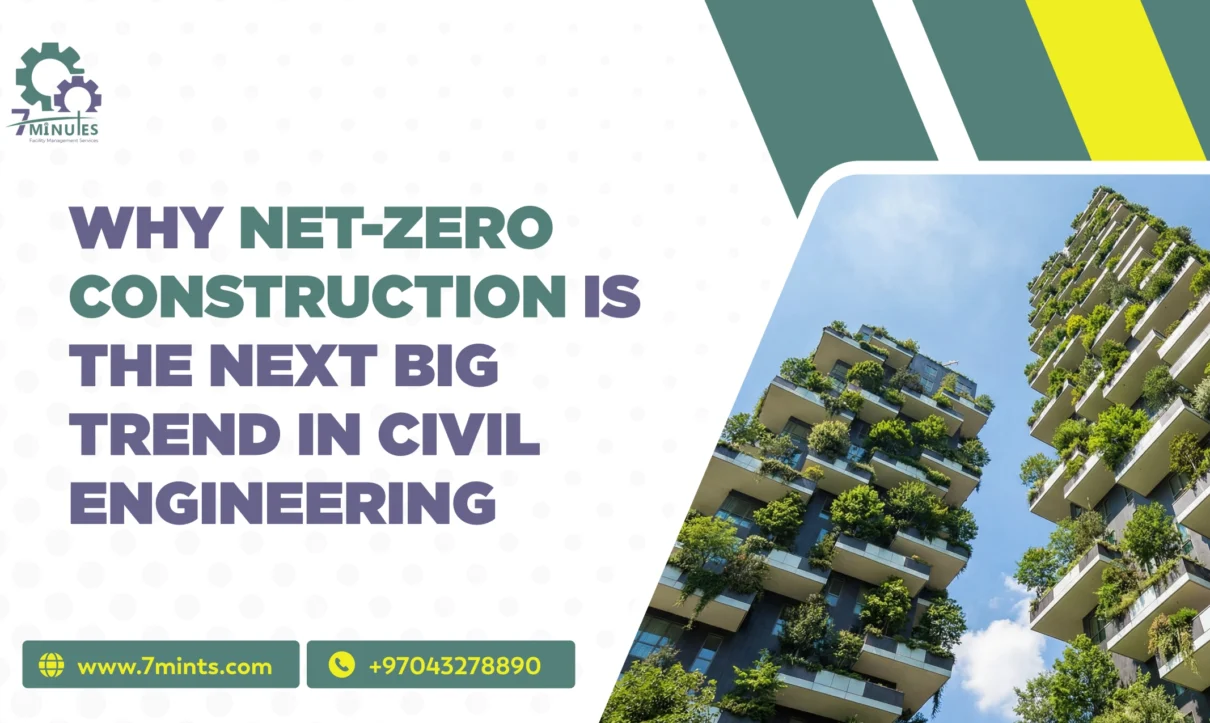
Net-zero construction is virtually the greatest movement in the modern infrastructure world. At no time have the needs for sustainable and energy-efficient buildings been so high, and the demand to meet climate goals, along with the rapid growth of cities, has contributed to it. The civil engineers are now at the forefront of designing buildings that use very little energy and release the rest through renewable systems.
Due to the growing concerns about the environment, the setting of global sustainability targets, and the rise in electric power prices, net-zero construction is gradually becoming a trend that will alter the future of civil engineering. We are going to analyze what net-zero construction is, the reason for its being en vogue, and its role in the future of the developed environment in this blog.
What Is Net-Zero Construction?
Definition of Net-Zero Energy Buildings
Buildings that are classified as net-zero energy buildings (NZEBs) are those that, over the course of a year, produce as much energy as they consume, primarily by making use of solar energy, energy-saving systems, and intelligent technologies. Besides that, such buildings are designed to have their power consumption reduced at the source by utilizing advanced materials, insulating properly, sourcing lighting from nature, etc.
The energy equilibrium is the reason for the building’s exceptionally small or nearly nonexistent carbon footprint. Consequently, NZEBs not only ensure energy billing savings but also lower the environmental impact since they are not only friendly but also preferred in construction.
Difference Between Net-Zero Energy and Net-Zero Carbon
Net-zero energy and net-zero carbon are often confused terms, but in fact, they each mean something different. Net-zero energy refers to the situation where a building uses and generates the same amount of energy, while net-zero carbon is about the total elimination of carbon emissions in both the construction and operation of the building. As an illustration, if a building produces solar power but at the same time consumes materials that have very high carbon footprints, this would not be considered net-zero carbon, whereas the building would be considered net-zero energy.
The distinction between net-zero energy and net-zero carbon is very crucial for civil engineers, as each standard requires specific tactics and specific materials. Nevertheless, the two standards play major parts in the world’s fight for sustainability.
Why the World Is Moving Toward Net-Zero Standards
Countries are introducing strict climate regulations, and many have pledged to be carbon neutral by 2050 at the latest. As a consequence, governments and industries are strongly advocating for the net-zero construction approach to mitigate the adverse environmental impacts.
Additionally, factors such as global warming, pollution, and heat are making it a necessity for builders to adopt greener ways of working. The net-zero standards, however, are an added financial advantage in the long run, as energy-efficient buildings help reduce operating costs and increase property value. This worldwide trend is the reason behind the constant growth of the net-zero construction sector and its power.
Why Net-Zero Construction Is Becoming a Big Trend
Growing Environmental Regulations
eco-friendly practices and reduce their carbon footprint. It’s now common for large corporations to not only set internal sustainability goals but also take over innovative green projects in the real estate sector. Sustainability has become an essential strategy for firms to enhance their image and attract and retain customers.
Investors Supporting Green Trends
Investors are becoming more eco-conscious and are thus supporting the green trends in the real estate market. Organizations and individuals with social responsibility concerns are pushing developers towards green buildings by only investing in projects with sustainable features or even by offering lower interest rates for eco-friendly projects.
While certain trends are making climate-resilient structures costly, the opposite is true for the investors’ participation in this sector. Apart from the financial gains, a green label still brings a lot of marketing benefits.
Government Incentives
Governments worldwide are still providing tax incentives, rebates, and grants as part of their energy efficiency and renewable energy programs. Even though the financial incentives from the governments are considerably lower in comparison to other drivers of net-zero buildings, the majority of developers still consider them one of the reasons for their participation in the eco-friendly building sector. Developers still appreciate the boost that the tax incentives give to their projects.
The Need for Sustainable Solutions
The demand for sustainable housing solutions is another factor contributing to the rise of net-zero construction. It is always the case when the consumer’s choice is that sustainability is the core of the matter.
According to the World Bank, the global population is expected to reach 9 billion by 2050, which will add pressure on the already stressed housing and infrastructure sectors to meet the needs of new customers through sustainable means. However, the good news is that the housing issue can be addressed through the net-zero approach.
How Civil Engineers Are Making Net-Zero Possible
Efficient Building Designs
Civil engineers are applying state-of-the-art design methods that cut down energy consumption by taking full advantage of Mother Nature. They literally do everything from optimizing the building’s orientation to maximally allowing natural light inside, providing better ventilation, and even installing better insulating materials. When a building is poorly designed, it consumes more electricity for heating, cooling, and lighting. The engineers’ use of tools like BIM (Building Information Modeling) helps them in evaluating energy performance even before the actual construction starts.
Advanced Construction Materials
The use of new-generation materials is a big help for civil engineers, who are now able to come up with greener and sturdier structures. Environmentally friendly construction is made possible with the application of low-carbon concrete, recycled steel, and the use of eco-friendly insulation materials.
Besides being eco-friendly, these materials are also good performers in buildings since they allow less heat transfer, need less maintenance, and last longer. Material technology development ensures that buildings with net-zero energy consumption are not only easier but also cheaper.
Integration of Renewable Energy
Solar energy systems such as solar panels, geothermal systems, micro wind turbines, and solar water heaters are now commonly a part of building designs. Civil engineers are taking the right steps to place these systems where they can be most efficient. The production of renewable energy not only decreases the electricity bill but also makes the power from conventional sources a little less relied upon. This fusion is a major contributor to the aim of zero-energy buildings.
Smart Building Technology
State-of-the-art premises that are trying to be sustainable use the latest technology in terms of sensors and automation systems that manage the lighting, the temperature, the security, and the overall energy consumption. The use of smart meters makes it possible to monitor the energy consumption in real time, which in turn helps the residents to make better decisions.
AI systems can also forecast energy demands and alter operational control in buildings. This integration of engineering, building, and electrical services is what makes buildings that achieve net-zero energy easily fluctuate.
Key Components of a Net-Zero Building
High-Performance Building Envelope
A high-performance building envelope consists of insulated walls, advanced windows, airtight doors, and reflective roofing materials. These characteristics prevent the unwanted transfer of heat in and out of the building and thus, less cooling and heating are required mechanically. This energy saving is really very substantial and will be very helpful in the net-zero building maintenance. The building envelope is one of the major factors in construction that supports the net-zero concept.
Efficient HVAC and Lighting
The usual HVAC installations require a great deal of energy; on the other hand, the net-zero buildings use super-efficient air-conditioning, heat pumps, and smart thermostats. These setups are capable of climate control, albeit through very low power consumption. Besides LED lighting, motion sensors and daylight-based controls are also effective in bringing down the power consumption. All in all, the improvements in HVAC and lighting are collectively substantial for attaining a major reduction in energy consumption.
Renewable Energy Production
Solar photovoltaic panels are the primary renewable energy source in the majority of net-zero buildings. These facilities contribute to the provision of clean power that covers the building’s annual energy requirement. Ultimately, the more renewable energy produced, the less the building will have to depend on the grid to maintain its net-zero status.
Water Conservation Systems
Water-efficient installations, rainwater reclamation, and greywater recycling are the mainstays in the reduction of the overall resource consumption of the building. Moreover, all these activities also cut down the energy consumption for water heating and treatment. Water-efficient civil engineering plumbing systems help the comfort and functionality factor to continue unaffected. This integrated working allows the building to be environmentally friendly in all operations.
Net-Zero Construction Advantages
Reduced Operational Costs
Net-zero buildings emit zero electricity and water bills. Despite the fact that the cost of construction is higher at first, the savings in the long run make these buildings financially viable through investment. In the end, the savings usually surpass the initial costs, thus making them a wise financial move for both homeowners and businesses. This economic benefit is one of the primary reasons why net-zero construction is becoming more and more popular.
Indoor Comfort and Health Improvement
Net-zero buildings are completed with sophisticated ventilation systems, top-quality insulation, and non-toxic indoor components. This results in better air quality and better humidity control, and also the temperature is quite good all throughout the day. Natural daylight also contributes to mental well-being and less dependency on artificial light. Thus, net-zero buildings are the ones that offer healthier and more pleasant places to live and even work. Check out our latest blog post on What Do Civil Engineers Actually Do?
Lowered Environmental Footprint
Net-zero buildings produce no carbon emissions, generate less waste, and use little natural resources. This is a great help in the fight against global warming and in preserving the environment for the generations. Net-zero construction has an enormous positive impact, as the construction sector is a major contributor to global emissions. Every net-zero building indeed contributes to a more sustainable future.
Increase in Real Estate Value & Demand in the Market
The green buildings are that much desired by the market as the buyers and renters have a great preference for eco-friendly and energy-efficient buildings. The market for net-zero properties often includes higher resale values, lower vacancy rates, and good reputations. The developers who go for net-zero construction bring themselves to the forefront in terms of competition in the real estate market. The trend will become more pronounced as the demand increases.
Obstacles to Net-Zero Construction
Higher Initial Costs
The net-zero buildings would be constructed by employing advanced materials having quality insulation, among other things, while the use of systems for energy from renewable sources would also be an accessory.
The incorporation of these features would increase the upfront cost of the whole building construction. The energy savings during the long run and maintenance costs that are also lower will also cover this investment. Understanding the cost-benefit curve clearly will be beneficial for both the builders and clients in their decision-making.
Skill Gaps in the Workforce
The construction sector that is sustainable will need specialists with the right qualifications and trained professionals. A large number of construction workers and contractors have no practical experience with green building techniques, and they are still relying on outdated methods.
This gap in skilled labor is a major barrier to the very slow acceptance of net-zero practice. The introduction of training programs and revisions of the engineering curriculum will be necessary to facilitate the transition.
Climatic & Geographical Constraints
There are some areas that have very little sunlight or are constantly experiencing harsh weather conditions, which result in zero energy generation. In such instances, it will be the designer’s responsibility to think of alternative methods and technologies to maintain the balance of energy consumption and generation.
Limited Awareness Among Developers
A few manufacturers are still putting their money on short-term profits rather than on long-term benefits. They might be reluctant to commit resources to net construction because they are misinformed about cost and complexity. This mentality is slowly being overturned through the combination of increased awareness, government policies, and consumer demand.
Conclusion
Net-zero construction is no longer just a fad; it has become the future of civil engineering. Civil engineers are at the forefront of this transformation by developing non-polluting buildings, reducing the cost of energy, and offering more pleasant indoor atmospheres. Net-zero buildings will be a significant force and will shape the future of our planet’s infrastructure through strict government regulations, contact us as rising energy costs, and global climate commitments. By embracing this movement now, we can hand over to the future a cleaner, greener, and more resilient world.



1 Comment
Comments are closed.