

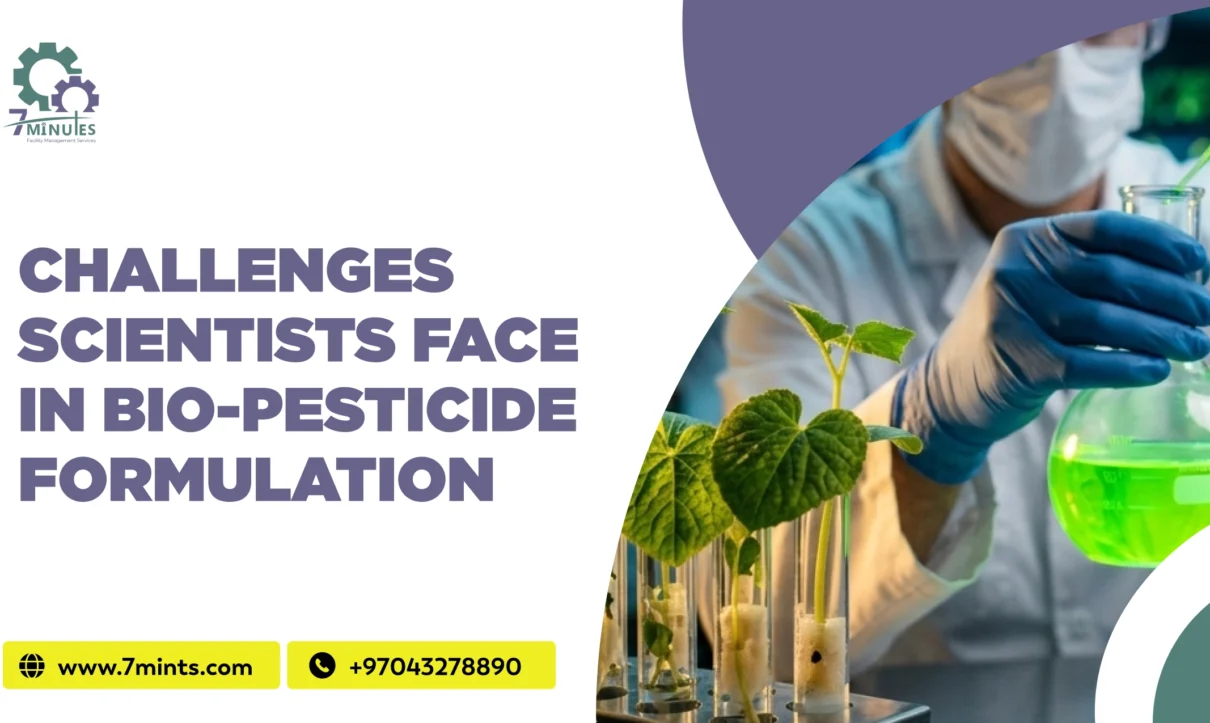
The growing demand for sustainable agriculture and environmentally responsible pest management has increased interest in biological pesticides. Unlike conventional chemical pesticides, bio-pesticides use naturally occurring microorganisms, plant extracts, and other biological substances to manage agricultural pests. They offer potential benefits such as reduced environmental impact, targeted pest control, and compatibility with integrated pest management practices.
However, developing effective biological pesticides involves several scientific and technical challenges. From maintaining microbial activity to ensuring product stability and extending shelf life, researchers must overcome multiple obstacles before a formulation becomes commercially viable.
The increasing demand for bio-pesticide formulation UAE solutions also highlights the importance of developing products that can withstand challenging environmental conditions while maintaining their effectiveness.
This article explores the major bio-pesticide formulation challenges scientists face and the technologies and research approaches that can help address them.
1. Maintaining Stability of Active Biological Ingredients
One of the biggest challenges in biological pesticide development is maintaining the stability of active ingredients. Many bio-pesticides contain living microorganisms such as bacteria, fungi, and viruses that must remain viable to deliver effective pest control.
Unlike conventional chemical pesticides, microbial products can be sensitive to temperature, moisture, ultraviolet radiation, and environmental conditions.
These factors can reduce microbial activity and affect product performance during manufacturing, transportation, and application.
Scientists must address different bio-pesticide stability issues by selecting suitable formulation ingredients, protective carriers, and stabilising agents.
For example, certain microorganisms may require protective materials that reduce exposure to moisture and environmental stress.
Research into microbial bio-pesticide stability is therefore essential for developing reliable products that maintain their biological activity throughout their intended storage period.
2. Extending Bio-Pesticide Shelf Life
Shelf life is another important consideration in biological pesticide development. Products containing living microorganisms may lose viability over time, particularly when stored under unsuitable conditions.
A shorter shelf life can create challenges for manufacturers, distributors, agricultural suppliers, and farmers.
Maintaining an acceptable bio-pesticide shelf life requires scientists to evaluate the effects of temperature, humidity, packaging materials, and storage duration.
Different microorganisms have different survival requirements. Therefore, a formulation suitable for one biological agent may not work effectively for another.
Researchers explore several approaches to improve product longevity, including:
- Developing protective encapsulation systems.
- Selecting suitable carrier materials.
- Optimising moisture levels.
- Using compatible stabilising ingredients.
- Testing different packaging materials.
- Evaluating microbial viability during storage.
Understanding suitable bio-pesticide storage conditions is equally important. Manufacturers must provide clear storage recommendations to help preserve product quality and performance.
3. Overcoming Microbial Formulation Challenges
Microbial pesticides are commonly developed using beneficial bacteria, fungi, and other microorganisms that target specific agricultural pests.
However, incorporating living organisms into a stable and effective commercial product is technically demanding.
One of the major microbial pesticide formulation challenges is maintaining microorganism viability while ensuring that the product remains easy to manufacture, transport, store, and apply.
Scientists must consider factors such as pH, moisture content, compatibility with other ingredients, and the physical properties of the final product.
The formulation of microbial pesticides may involve different product types, including wettable powders, liquid suspensions, granules, and emulsifiable formulations.
Each formulation type has different requirements for stability, handling, and application.
Researchers must conduct extensive laboratory testing to identify suitable combinations of active microorganisms and formulation ingredients.
4. Maintaining Consistent Product Efficacy
Another important challenge is ensuring that bio-pesticides deliver consistent pest control results under different environmental and agricultural conditions.
Biological products can be influenced by sunlight, rainfall, soil conditions, temperature, humidity, and the target pest’s life cycle.
These variations may affect how effectively a biological pesticide performs after application.
Scientists must investigate bio-pesticide efficacy challenges through laboratory experiments, greenhouse studies, and field trials.
Testing should evaluate:
- Target pest mortality or suppression.
- Microbial survival after application.
- Performance under different temperatures.
- Resistance to environmental stress.
- Application frequency and dosage.
- Consistency across different crops and locations.
Developing reliable formulations requires understanding how biological agents interact with their target organisms and surrounding environments.
5. Addressing Manufacturing and Production Challenges
Scaling laboratory research into commercial manufacturing is another major obstacle in biological pesticide development.
A formulation that performs well in a laboratory may not maintain the same quality when produced in large quantities.
Manufacturers must ensure that microorganisms remain viable during fermentation, harvesting, processing, formulation, and packaging.
These bio-pesticide production challenges can affect product consistency, manufacturing costs, and commercial scalability.
Scientists and production teams must establish standardised procedures to maintain microbial concentration, purity, and product stability.
For companies involved in bio-pesticide manufacturing UAE, developing suitable production infrastructure and quality management systems is important for supporting reliable product development.
Investments in modern manufacturing equipment, controlled production environments, and technical expertise can help improve production efficiency.
6. Maintaining Quality Control and Product Consistency
Quality control plays an essential role in ensuring that biological pesticides meet the required safety, quality, and performance specifications.
Unlike many conventional chemical products, microbial formulations require careful monitoring of biological characteristics in addition to their physical and chemical properties.
Effective bio-pesticide quality control may include:
- Microbial identification and purity testing.
- Viable microorganism count measurements.
- Contamination monitoring.
- pH and moisture analysis.
- Stability and shelf-life testing.
- Packaging compatibility assessments.
- Product efficacy evaluations.
Maintaining consistent quality across production batches is important for building customer confidence and supporting commercial acceptance.
Manufacturers must also follow applicable regulatory requirements and product registration procedures in their target markets.
7. Developing Effective Natural Pesticide Formulations
Bio-pesticides may contain plant-derived ingredients, microbial agents, or other biological substances. Each active ingredient presents different formulation requirements.
For example, botanical extracts may contain compounds that degrade when exposed to sunlight, oxygen, or unsuitable storage conditions.
Scientists must identify ways to protect these active substances while maintaining their biological effectiveness.
Modern natural pesticide formulation techniques include encapsulation, controlled-release systems, suitable carrier selection, and the use of compatible stabilising ingredients.
These approaches can help improve product handling, protect sensitive active compounds, and support consistent performance.
However, selecting appropriate ingredients requires detailed compatibility testing to ensure that the formulation does not reduce the activity of the biological agent.
8. Adapting Formulations to UAE Climate Conditions
Environmental conditions are particularly important when developing biological pesticide products for different geographical markets.
In the UAE, high temperatures, intense sunlight, and varying humidity levels can create additional challenges for biological products.
Scientists developing bio-pesticide formulation UAE solutions must consider how local environmental conditions affect product storage, transportation, and field performance.
For example, high temperatures may reduce the viability of certain microorganisms if products are not adequately protected.
Similarly, ultraviolet radiation can affect sensitive biological agents after application.
Research into suitable packaging, temperature-controlled storage, protective formulations, and application recommendations can help address these challenges.
Developing climate-appropriate biological pest control solutions UAE can support agricultural sustainability while helping farmers manage pest-related problems.
9. Supporting Sustainable Bio-Pesticide Research and Development
The development of effective biological pesticides requires continuous scientific research, experimentation, and innovation.
Bio-pesticide research and development involves identifying suitable biological agents, evaluating their effectiveness, developing stable formulations, and conducting safety and performance assessments.
Scientists must also consider how biological pesticides interact with beneficial insects, soil microorganisms, crops, and surrounding ecosystems.
These considerations are important for responsible eco-friendly pesticide development.
A major objective of research is to develop products that provide effective pest management while reducing unnecessary environmental impacts.
Although biological pesticides can offer sustainability advantages, their environmental safety and effectiveness must be evaluated individually.
10. Building Reliable and Sustainable Formulation Technologies
The future of biological pest management depends on overcoming technical limitations and developing commercially reliable products.
Researchers are exploring advanced encapsulation technologies, improved carrier materials, fermentation optimisation, and controlled-release formulations.
These innovations can help address several challenges in biological pest control, including microbial degradation, inconsistent performance, and storage limitations.
Developing effective sustainable pesticide formulation methods also requires collaboration between scientists, agricultural experts, manufacturers, and regulatory authorities.
Continued investment in research and technology can improve product quality, manufacturing efficiency, and accessibility for agricultural users.
Conclusion
Developing effective biological pesticides involves several scientific and commercial challenges. Maintaining microbial stability, extending shelf life, ensuring consistent efficacy, managing manufacturing processes, and maintaining product quality are among the most important considerations.
Addressing these bio-pesticide formulation challenges requires continuous research, advanced formulation technologies, and comprehensive quality testing.
As demand for sustainable agricultural solutions increases, innovations in biological pesticide development will play an important role in modern pest management.
For manufacturers and researchers in the UAE, investing in climate-appropriate formulations and reliable production methods can create opportunities to develop effective biological pest control products.
By focusing on innovation, scientific validation, and sustainable development, the industry can move towards more reliable and environmentally responsible pest management solutions.




1 Comment
Comments are closed.