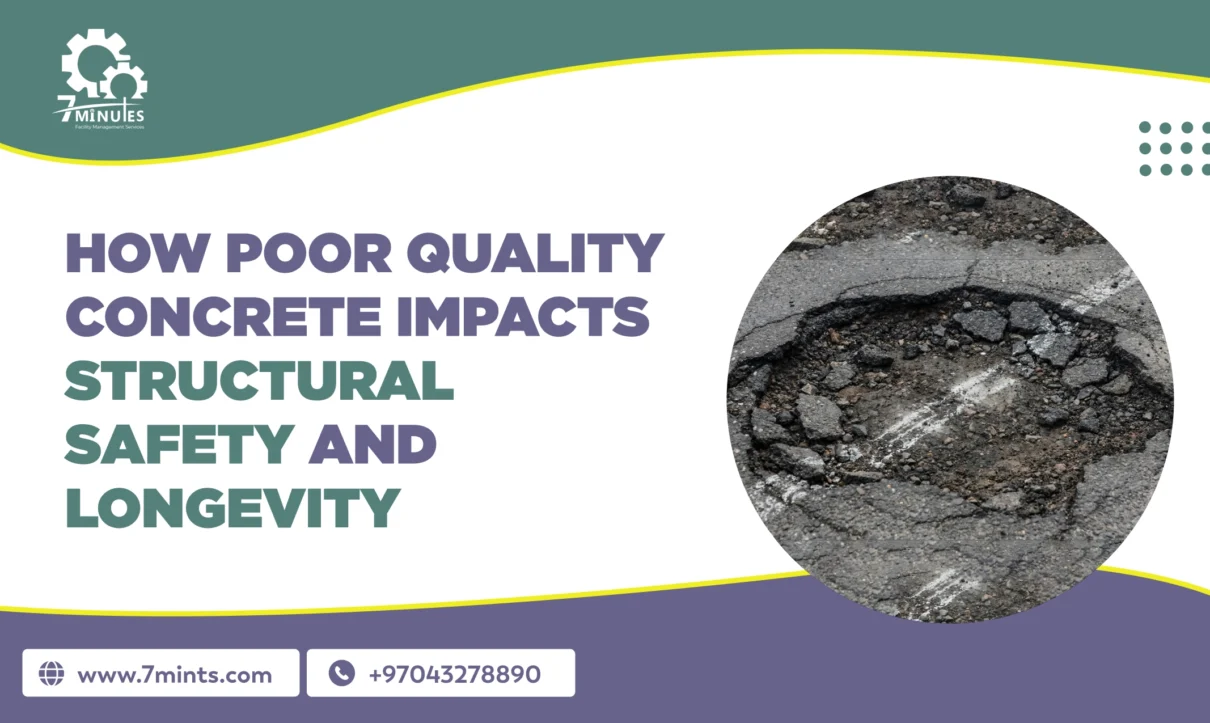
Poor-quality concrete affects structural safety and longevity mainly by reducing compressive strength, accelerating crack development, and allowing water and air to reach the steel reinforcement hidden within. Once that happens, corrosion ramps up, spalling follows, and the structure gradually loses load-bearing capacity. In some cases, what was meant to be a 50-year service life can shrink down to something like 10–15 years, and later you end up paying for retrofitting, repairs, or, if it’s really severe, even serious failure risks.
Individuals noticed a hairline crack on the wall about six months after handover. Then, another one shows up, wider too, near a column. And suddenly you’re thinking: is it only cosmetic, or was the concrete underneath never actually right from the start? Honestly, that concern makes sense. Poor-quality concrete is one of the most common, and also one of the easiest to prevent, causes of structural damage across residential, commercial, and infrastructure projects. By the time the obvious cracks and stains start appearing, the internal issues are often already pretty advanced.
This guide explains how poor-quality concrete erodes a building’s safety and long-term performance, what typically causes it, and the practical steps that stop it early – plus a cost and timeline breakdown, so you know what you’re getting into.
What Is Poor-Quality Concrete?
Poor-quality concrete is basically concrete that doesn’t meet its intended compressive strength or durability because of a wrong mix design, weak or questionable raw materials, too much mixing water, or curing that is just not done properly. Instead of forming a dense, stable matrix, it stays too porous, so later it invites moisture and aggressive substances to work their way in, slowly but steadily.
A concrete mix is judged by three things – the cement-to-water ratio, the quality of aggregates, and curing time. Mess up any one of these, and the whole structure ends up carrying that weakness, like it was baked in, from the start.
Why Concrete Quality Matters for Structural Safety
Concrete quality matters because it directly decides how much behaviour – press beam, or slab can safely take across its whole service life—not just the day it’s poured. Structural repair costs tell the story of how costly this becomes when quality is ignored at the beginning: damaged decks and balconies alone cost the U.S. construction industry up to $3.5 billion every year in repairs, and those losses link right back to early material and workmanship failures.
In a hot, wet, coastal environment like the UAE, the risk grows quicker too, because heat, salty air, and expansion cycles—similar in effect to freeze-thaw behaviour—press against weaker concrete far more intensely than they do against well-cured, dense concrete.
Check out our latest blog post on Common Issues with Construction Materials and How to Avoid Them
7 Ways Poor Quality Concrete Hurts Structural Safety and Longevity
Weak concrete doesn’t break in just one direction; it fails on several fronts at the same time, and each issue speeds up the rest.
1. Weak compressive strength – An incorrect cement-sand-aggregate-water ratio, or too much added water for ease of placement, dilutes the cement paste and cuts the load-bearing capacity of columns, beams, and slabs.
2. Cracks show up sooner and widen – low density plus poor curing can cause cracks to appear earlier and spread faster, creating a direct route for moisture, oxygen, and aggressive chemicals to reach the deeper parts of the structure.
3. Corrosion of steel reinforcement – Porous concrete soaks up water and chemicals that rust the embedded steel bars; as the rust swells, it cracks the surrounding concrete, which leads to spalling.
4. Less durability, shorter lifespan – A structure built for 50 years can end up failing well before that, sometimes even while it still looks fine on the surface.
5. Water seepage and moisture damage – Porous concrete kind of lets water slip into walls, slabs, and foundations, causing dampness, mould, paint peeling, and later soil softening beneath the foundation base; yes, it builds up over time, not just once.
6. Poor resistance to environmental stress – Heat, salt air, humidity, and freeze-thaw cycles wear down weak concrete way faster than dense, well-cured concrete, especially around coastal and industrial zones where exposure is more or less constant.
7. Structural instability and collapse risk – Once weak concrete breaks the load path through columns , beams , and foundations, the whole building becomes kind of unreliable under wind, seismic, or even routine daily stresses, and in extreme situations it can end with partial or full collapse.
What Actually Causes Poor-Quality Concrete?
Poor-quality concrete is usually the outcome of choices made before or during the pour, not some bad luck after the fact. The more common reasons are the following:
- Incorrect mix design – wrong cement-sand-aggregate-water ratio; sometimes people “eyeball it,” which is a bad sign
- Adding extra water on-site just to make the mix easier to pour, even if it ruins the performance
- Using substandard aggregates or fine, poor-quality sand; the particles matter more than most folks think
- Skipping or speeding up curing, because someone says it can’t possibly matter
- Poor site supervision and unskilled labor; the supervision gap is real
- Contaminated or low-grade cement and water; muddy water is a classic problem
- Suppliers reducing material costs to protect margins, often quietly done
Common mistakes that lead to structural problems
- Even experienced teams often repeat a couple of avoidable errors that turn an average batch into a structural problem:
- Skipping cube testing before and during the pour, so weak lots go unnoticed
- Curing for less than 7 days because it “looks dry enough” on the surface, but inside it’s still developing.
- Ignoring honeycombing (those visible voids from poor compaction) instead of flagging it for correction.
- Pouring fresh concrete against partially set concrete, which forms a weak cold joint.
- Using recycled aggregate without proper testing, which can lower strength in a subtle way you don’t see right away.
A Real-World Example
High-profile failures show how far this can go when it isn’t caught early. China’s Ping’An Finance Centre, once set to be the country’s tallest building, drew controversy in 2013 when it was judged unsafe to work on after concrete mixed with beach sand was discovered on it. Beach sand carries salt and chloride contamination that attacks the steel reinforcement; it’s kind of a shortcut that looked identical to a proper mix at the pour stage, but it creates a corrosion risk that basically only shows up if you test it thoroughly. It’s a reminder that poor-quality concrete rarely announces itself right away; it turns up later, in the reinforcement.
Step-by-step process to ensure high-quality concrete
- Get a certified mix design from a structural engineer or a materials specialist; make sure it matches the specific loads and the environment it’s facing.
- Source certified raw materials—cement, aggregates, and water—from verified suppliers, not just the cheapest available options.
- Control the water-cement ratio strictly during batching, and never add extra water on site just to make placement easier.
- Compact the concrete properly during placement; this helps eliminate air voids and also those honeycombing spots.
- Cure for at least 7–14 days; keep the surface consistently moist so the strength-building chemical reaction can finish.
- Run cube tests at set intervals, often at 7 and 28 days, so you can confirm the mix actually hits its designed compressive strength.
- Maintain third-party site supervision, so mix ratios, curing, and compaction are verified independently, not self-reported.
Concrete Repair Cost and Timeline: What to Budget For
| Repair Type | Typical Timeline | Approx. Cost Range |
| Crack sealing / epoxy injection | 1–3 days | $150–500 per crack |
| Spalling repair (surface patching) | 2–5 days | $250–600 per sq ft |
| Jacketing/grouting/retrofitting | Several weeks | $8–15+ per sq ft, plus $2,000–10,000 engineering fee |
| Full section replacement | Weeks to months | Highest cost tier; project-dependent |
Cost ranges are indicative and vary by region, structure type, and damage severity – always get a site-specific quote from a licensed engineer or contractor.
Here’s what each repair type actually involves:
- Crack sealing / epoxy injection — used for hairline to medium cracks; epoxy is injected under pressure to restore bond strength, usually completed in a single site visit.
- Spalling repair — removes damaged, corroded concrete around exposed reinforcement, treats the rusted steel, and patches the surface with polymer-modified mortar.
- Jacketing, grouting, and retrofitting — Reinforces a weakened column, beam, or slab by adding new concrete or composite wrapping around the existing structure; requires a structural engineer’s design.
- Full section replacement — the last resort when damage has gone too far to repair; the affected section is demolished and rebuilt to the original structural specification.
Conclusion
Poor-quality concrete rarely looks like an actual problem on day one; it more often looks like a shortcut that saved time or a bit of money. Later, the bill arrives in the form of cracked columns, rusted reinforcement, and repair costs that outpace what better materials would have cost from the start. If you’re seeing early cracks, dampness, or a crumbling surface.
FAQs
Q1. What is the main cause of poor-quality concrete?
Usually it comes down to an incorrect mix ratio, and it’s often made worse when excess water is added on-site just to make the pour smoother; it ends up diluting the strength.
Q2. How can I tell if concrete is poor quality after it’s cured?
Check for early or wide cracking, a chalky or crumbling surface, honeycombing (those visible voids), discolouration, or damp patches. In all these cases, it’s a good idea to arrange a professional inspection, sooner rather than later.
Q3. Can poor-quality concrete be repaired, or does it need replacing?
Small defects, like narrow cracks, may be repaired using epoxy injection or patching, but when corrosion is already in play or when the load-bearing ability is reduced, then structural retrofitting or a section replacement is typically needed.
Q4. How long does poor-quality concrete take to show problems?
Timing varies, but structures with poor-quality concrete can develop serious distress in about 10–15 years. Well-built ones often last 50+ years before major issues become obvious.
Q5. Does curing time really make that much difference?
Yes. Concrete needs about 7–14 days of steady moisture to finish the chemical reaction that develops strength, and cutting curing short is one of the most common hidden causes of long-term weakness.
Q6. Is poor-quality concrete more dangerous in coastal areas like the UAE?
Yes, absolutely. Salt-heavy air and high humidity speed up steel corrosion in porous concrete far faster than in inland, drier climates, so quality control matters even more here.