

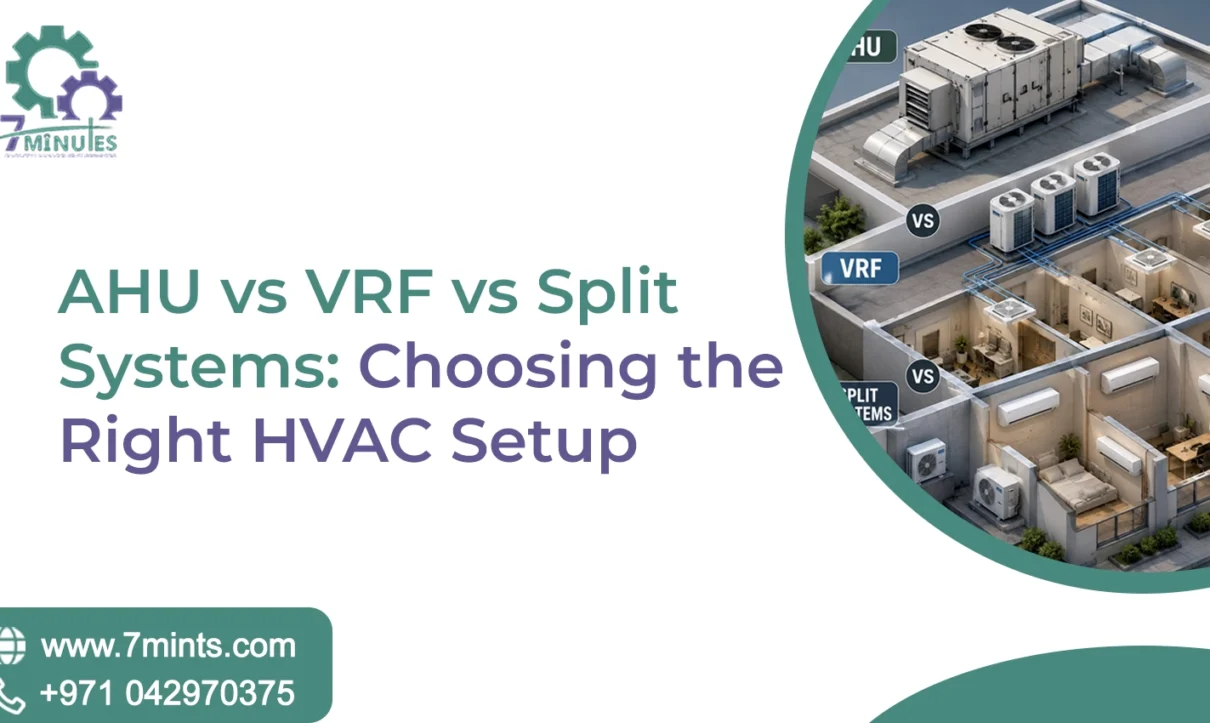
Dubai’s hot climate makes air conditioning an essential part of residential and commercial buildings. Choosing the right HVAC system can affect indoor comfort, energy consumption, maintenance requirements, installation costs, and the long-term performance of a property.
Among the most commonly considered options are AHU (Air Handling Unit) systems, VRF (Variable Refrigerant Flow) systems, and split air conditioners. Each system has different applications, advantages, and limitations.
The right choice depends on the property’s size, layout, occupancy, cooling requirements, budget, and ventilation needs. Dubai’s building requirements should also be considered during system design. Dubai Municipality provides specific building-code requirements and AC-unit calculation schedules for building projects.
What is an AHU?
An air handling unit, or AHU is a key part of a building HVAC system. It brings in air. That air can come from outdoors or from the building itself. After that, the unit runs the air through filters. Then it moves large volumes of air through ducts to different rooms.
An AHU does not cool by itself. It relies on a chiller to do that work. The chiller makes chilled water and sends it to the AHU. When the chilled water gets to the AHU, it goes through a coil. Air that passes across this cold coil loses heat. Since the air has already been filtered, it is also cleaner. After the process, the AHU sends the cooled air through the duct network to the areas that need it. AHUs are used very often in buildings.
AHUs are typically the backbone of HVAC systems in
- Shopping malls and other big retail sites
- Hospitals and healthcare buildings
- Airports, hotels, and tall office blocks
- Factories and warehouses that need strong ventilation
Key benefits include good air filtration, steady fresh air delivery, strong ability to meet large cooling needs, and central control. That central setup can also make maintenance easier for the site team.
There are downsides too. AHUs usually need a plant room to fit the equipment, plus a lot of ductwork. They also require a chiller or a boiler. All of that can raise the start cost. You also need trained staff for upkeep.
What Is a VRF System?
A VRF system uses one outdoor condenser. It links to several indoor units. Each indoor unit can vary the refrigerant flow on its own. That lets each zone cool or heat only as much as it needs. So one part of a building can run at a different level than another, without dumping extra energy into spaces that do not need it.
VRF is now a common pick for many mid-rise commercial and hospitality jobs in the UAE. People choose it because it offers solid efficiency and flexible zone control. Systems that rely on ducting often do not provide the same level of match to changing demand.
In Dubai, VRF setups are often seen in these types of projects.
- Office spaces and co-working areas, where use changes over time
- Hotels and serviced apartments
- Clinics and diagnostic centers that need quiet operation and tight control
- High-end villas and mixed-use buildings
Strengths include independent control by zone, a small indoor and outdoor footprint, lower power use over time when running at part load, and the option to warm one area while cooling another when heat recovery is supported.
Trade-offs include a bigger upfront installation cost than split systems, plus repairs that must be done by certified techs from the brand, not by regular AC maintenance crews.
What Is a Split AC System?
A split AC system keeps the cooling parts apart. One section sits indoors and sends out cooled air. The other sits outside and pushes the heat away. The two parts connect with refrigerant lines. Each indoor head usually covers one room or a small area. This setup is the one most people know best, and it is also the most common choice for homes and small sites in the UAE.
For commercial work, split systems are often sold in a few forms. There are ducted versions for small offices where air needs to move in a cleaner way. There are also cassette models that fit above ceilings in shops and restaurants.
Strengths of splits are usually the lowest initial cost, simple installation, local service support, and no requirement for a shared plant room.
Trade-offs are weaker zoning, more electricity use per ton when a system runs many hours, and less value when a building has a lot of rooms to cool.
AHU vs VRF vs Split AC: Key Differences
| Feature | AHU (with Chiller) | VRF System | Split AC System |
| Best for | Malls, hospitals, towers, factories | Offices, hotels, clinics, villas | Homes, small offices, shops |
| Building size | Large (100,000+ sq ft) | Mid-sized, multi-zone | Small, single or few rooms |
| Zoning control | Centralized, less granular | Excellent, room-by-room | Good, but unit-by-unit only |
| Upfront cost | Highest | 20–40% above split systems | Lowest |
| Long-term running cost | Efficient for 24/7 continuous loads | Very efficient under variable loads | Higher per ton over long hours |
| Space required | Plant room + ductwork | Compact indoor/outdoor units | Minimal |
| Maintenance complexity | High — specialist technicians | Moderate — certified technicians | Low — widely available service |
Why the right HVAC choice is a big deal in Dubai
If you get this wrong, it affects more than comfort. It can raise your power costs, shorten equipment life, and create code issues under UAE rules. Research on VRF systems shows that heat recovery VRF units can cut on-site HVAC energy use by about 15% to 42% versus older-style setups.
The main reason is that these units adjust output to match what the building needs at that moment. They do not stay locked to one fixed level. In Dubai, cooling can be a major part of total electricity use for eight months or more each year. So the gap grows quickly. A system that does not fit the loads will not only cool less well. It can also push your DEWA bill up each month.
There are also costs you may not see right away. For example, split units that are too small for open-plan areas may struggle all day. AHUs that are too large can sit idle in spaces with changing occupancy. You can also run into problems when a VRF system is placed without proper load planning. That can lead to short cycling and early wear.
How to pick the right HVAC setup for your space
Use this order of steps before you sign any offer.
1. Pin down the building type and its size. A villa or small clinic needs different equipment than a 20-floor office block. Start by matching the system category to the scale.
2. Sort out zoning. Write down how many separate temperature areas you truly need. In many cases, more zones work better with VRF. If the building has large areas that stay fairly similar, an AHU and chiller approach can fit.
3. Do the cooling load math. Ask for a proper heat load study. This step drives equipment sizing. It is also the key thing that helps you avoid weak performance later.
4. Check space for the plant room and ceiling. AHUs and chillers usually need a real mechanical room plus duct risers. VRF units and split units usually take up much less space.
5. Check how the space is used in real life. Look at the daily and weekly patterns. See how busy it stays and how often the demand changes.
6. Think about how the building behaves. If the place runs most hours, day and night, and the heat load stays pretty steady, a chiller with AHU control can be a good match. This shows up in hospitals and in sites that work near data needs.
Mini case study: Office fit-out in Business Bay
A 15,000 sq ft office in Business Bay got an initial quote for a fully ducted AHU chiller setup. The sizing was based on the building shell and core spec. After a proper load check and a zoning review, the team shifted to a VRF layout. Heat-recovery indoor units served different areas such as departments, meeting rooms, and a server room that needs cooling year-round.
The change lowered the mechanical cost at the start compared with the AHU option. It also gave each department its own temperature control. During the shoulder seasons, VRF helped reduce the cooling demand on the electricity bill when occupancy and heat gains were lower. This kind of outcome shows up often in Dubai office projects. AHUs can work well for base-building systems, while VRF commonly does better for the tenant fit-out layer.
Check out our latest blog post on New Build vs Retrofit: MEP Considerations for Dubai Properties
AHU vs VRF vs Split systems Cost & Maintenance Comparison
| System | Typical Installation Cost (relative) | Maintenance Frequency | Typical Lifespan |
| Split AC | Lowest (baseline) | Every 3–4 months (filters/coils) | 8–12 years |
| VRF | 20–40% higher than split | Quarterly, by certified technician | 15–20 years |
| AHU + Chiller | Highest, plus plant room build-out | Ongoing specialist plant maintenance | 20–25 years |
Frequently Asked Question
Q1. What is the actual difference between an AHU and a VRF setup?
An AHU moves cold air through ductwork so it can serve many rooms from one place. A VRF system does it in another way. It sends refrigerant through pipe runs to separate indoor units, and each unit can be set and managed by itself.
Q2. Is VRF a better option than split AC for an office in Dubai?
It often makes more sense when your office is not just two or three rooms or when different zones need different temperatures. VRF costs more at the start, but many owners find that it uses less power and lets them fine-tune settings in each area.
Q3. Which system usually keeps electricity bills lower in the UAE?
For many buildings where use changes during the day, VRF often uses less electricity. Still, if a site needs cooling all the time, 24/7, and it runs near full load, an AHU with a chiller can work out better. Hospitals are a common example.
Q4. How long do VRF systems last versus split AC units?
With good care, a VRF system can run about 15 to 20 years. Split units often last around 8 to 12 years. In the end, wear and tear depends on maintenance and on how much the system is pushed.
Q5. If I install AHUs, do I need a chiller too?
In most situations, yes. The AHU is for sending and treating the air. It cannot chill air on its own. It relies on a chiller and, in some layouts, a DX coil to handle the cooling.
Q6. Do I need a chiller if I install AHUs?
In most configurations, yes – AHUs handle air distribution and filtration, but they rely on a chiller (or occasionally a DX coil) to actually produce the cooling effect.
Conclusion
Choosing between AHU, VRF, and split AC systems depends on much more than the size of your Dubai property. Each system has a different purpose.
Split AC is generally suitable for individual rooms and smaller spaces. VRF offers flexible zone control for villas, offices, hotels, and other multi-zone properties. AHU-based centralized systems are better suited to larger buildings requiring centralized air distribution and ventilation.
Before making a final decision, property owners should consider cooling load, ventilation, energy efficiency, building layout, installation cost, maintenance requirements, and Dubai’s applicable building regulations.
Not sure which system fits your property? Contact us for a proper load calculation and system comparison before you commit to a proposal.







1 Comment
Comments are closed.