

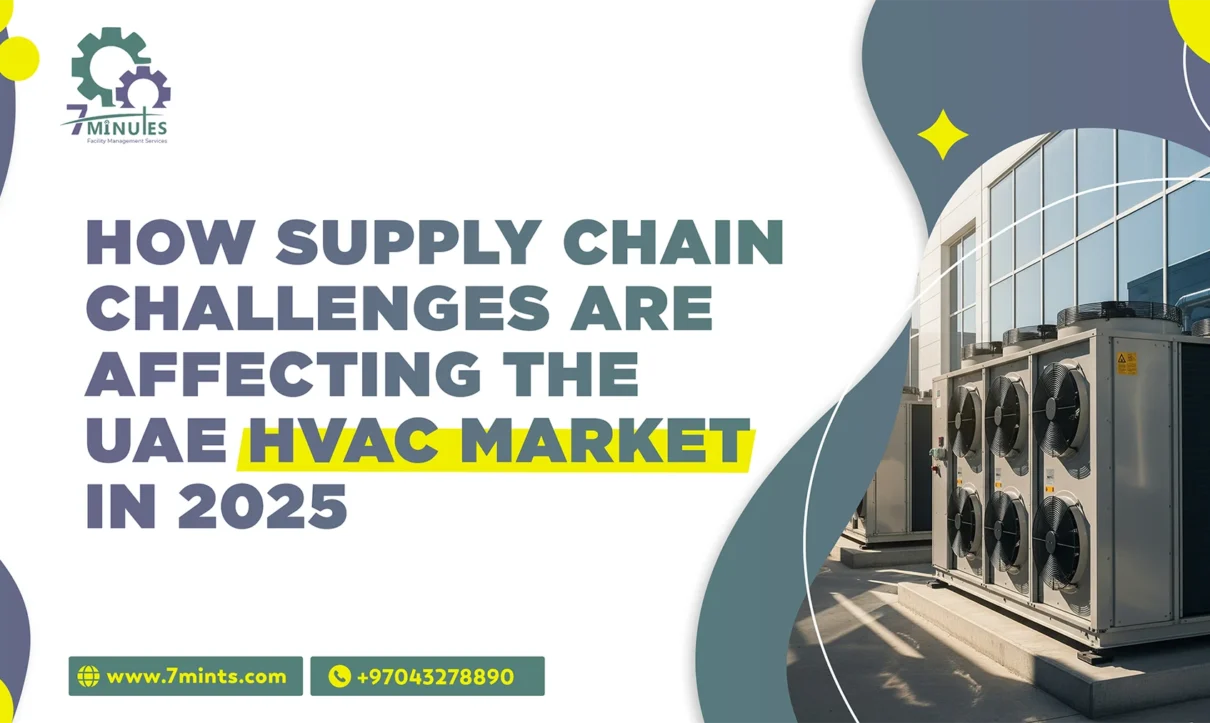
Rapid climate urbanization, the extreme climate conditions, and ambitious infrastructure projects have made the HVAC (Heating, Ventilation, and Air Conditioning) market boom in the UAE. With an ever-increasing demand for high-end HVAC systems and HVAC Market, logistically, the supply chain serves as the newfound hurdle. The disruption is guiding the market in a new direction, as it impacts manufacturers, distributors, and end-users.
What is the UAE HVAC Supply Chain Facing in 2026?
Think of the UAE HVAC supply chain as the full path the equipment takes. It starts at makers overseas, then moves through freight carriers and distributors, and ends at installers and job sites in the UAE. In 2026, many parts of this route are strained at the same time. Demand is steady, but the flow of goods is not smooth.
Market numbers also point to continued expansion. The UAE HVAC market was near USD 3.31 billion in 2025. It is expected to reach about USD 5.00 billion by 2032. That implies a forecast CAGR of around 6.06%. Growth is there, but it is being shaped by delays and shortages, not by an easy supply situation.
The UAE buys most of its HVAC parts from abroad. That means the market can get hit by events far away. If a shipment is delayed at a port overseas, or if copper supply gets tight, a project in Dubai can slip by weeks.
Why this happens in the UAE HVAC market
A big reason is that the country does not make many key parts at scale. Local production does not cover compressors, refrigerants, or microchips. When upstream supply changes, the effect shows up fast in the UAE.
1. Global shortages for key parts
The items that often sit on backorder are compressors, refrigerant gases, and control boards. Much of this work is done in Asia. When raw material supply dips, such as copper, aluminum, or chips, the shortage spreads. UAE distributors may have limited reserve stock, so they feel the gap.
2. Shipping slowdowns and port crowding
HVAC units sent to the UAE usually pass through more than one port. Costs for containers can jump, and freight space can get scarce. Congestion at stopover ports also adds delays. So the delivery time a supplier states in one month can change by the next.
3. Rules for Refrigerants keep changing
There is also a shift toward low-GWP refrigerants. This move comes from international rules and from UAE sustainability goals. Approved blends are not always easy to source. At the same time, older refrigerant stock is being phased out. Some contractors may struggle to match project dates when they need equipment that meets certification needs.
4. Not enough trained technicians
Parts are not the only problem. New HVAC systems require more skill to install. This is true for units with sensors and connected features and for newer energy-saving models. They need technicians who have the right training to do the job.
Why This Matters for Contractors and Developers
The impact is not just a late handover date. If a compressor shipment stops, a key construction step can stall. That can lead to contract fines, and it can throw the HVAC spend beyond the first plan. In the UAE, the HVAC space is expected to climb by almost 50% in value from 2025 to 2032. More work will flow through this supply chain. So teams that rethink sourcing sooner will be better positioned to meet deadlines later, even in 2028.
Check out our latest blog post on Solar-Powered HVAC: The Future of Cooling in the UAE’s Harsh Climate
How Supply Chain problems hit the same project
1. Long waits for compressors, refrigerants, and control boards can push installation dates back by weeks or even months.
2. Cost swings in raw inputs can land on contractors. That raises both purchase costs and ongoing upkeep.
3. Quotes that were agreed upon early may expire sooner. Suppliers often cannot keep prices steady when their own costs move each week.
4. Buyers may face pressure to accept replacements. When the preferred model is not ready, some end up with older and less efficient units.
5. Contract risk can grow quickly. If handover dates slip, penalty clauses may apply, and client trust can take a hit.
6. Delay can also come from certification needs. If green-certified or low-GWP equipment is not available on time, the schedule can break.
Step-by-Step: How to Manage HVAC Supply Chain Risk in the UAE
1) Use more than one supplier: Get key parts like compressors, refrigerants, and control boards from at least two different areas. That way, one disruption will not stop the entire job.
2) Keep extra units of risky items: Set aside a small buffer for parts that often run short. Do not rely only on a just-in-time approach for everything.
3) Put costs and delivery dates in writing early: Quote windows are getting tighter. Once the project plan is set, confirm the price and the delivery terms right away.
4) Plan for demand before the busy weeks: Get your summer must-haves ordered early so you are not stuck waiting in the rush.
5) Check what you can buy close to home: In the UAE, some assemblers and nearby sellers keep more stock on site. That can mean less risk from slow shipments coming from abroad.
6) Use better tracking: If your HVAC uses IoT sensors, it can warn you when something needs service. That helps avoid last-minute breakdown fixes when parts are hard to get fast.
7) Secure the people side too: Arrange trained installers and approved service teams ahead of delivery. Otherwise, the equipment may arrive and then sit unused until someone is available.
Trends Shaping the Next Phase of the UAE HVAC Market
Solar HVAC is also becoming more common. It can lessen pressure on the grid and help offset higher equipment prices, which fits the UAE climate.
1. More smart buildings are being built now. Green rules and building certification are also pushing buyers toward units with higher efficiency. Even so, getting certified models is still not as easy as it should be.
2. More local work is being set up over time. Local assembly for some items is starting to cut down how much firms depend on far-away imports.
3. Training programs are helping, but the technician shortage is still a real issue. Demand is growing faster than the number of certified installers.
Conclusion
From cost and timelines to product availability, supply chain challenges are reshaping the UAE HVAC market. However, from different pathways, businesses can still survive by incorporating local manufacturing plus smart technologies and green solutions. Contact Us for expert consultation and innovative HVAC solutions that will meet the unique needs of the UAE. Our expert team will help you with the challenges while accomplishing your project objectives with confidence!
Frequently Asked Questions
Q1. Why are HVAC supplies taking longer in the UAE right now?
One main issue is that compressor stock is low. Refrigerant availability is also not as strong as it used to be. In some orders, control boards arrive later too. At the ports, the process can take longer than before. Space on freight runs can be tight at times. There is also a move in the UAE toward refrigerants that have a lower GWP.
Q2. What delivery windows do people see in the UAE for HVAC parts in 2026?
It depends on what you are buying. Compressors and full VRF or chiller package systems often land in the 6- to 18-week range. In calmer times, before big world disruptions, the usual range was more like 3 to 8 weeks.
Q3. Do HVAC delays raise installation costs in the UAE?
They can. Prices may change fast. Material costs can move, and so can shipping and local transport fees. You usually see this during bid reviews. Some supplier quotes also do not stay valid for as long as they once did. Contractors may need to hold extra money for the wait.
Q4. Can HVAC work made in the UAE fix the supply problem?
It can reduce part of the delay. Local assembly and keeping some stock closer to job sites can cut down on long travel. But big parts, like compressors, refrigerants, and semiconductors, still often need to be sourced from outside the country.
Q5. What can contractors do to avoid HVAC project timing slips?
Using two or more suppliers can help. Another step is to order early for parts that often sell out first. Adding a buffer, about 15 to 20 percent, is also useful. After the project scope is set, keep the price notes and delivery terms written down.
Q6. Is the UAE HVAC market still expected to grow despite these delays?
Yes. The market is projected to grow from around USD 3.31 billion in 2025 to roughly USD 5.00 billion by 2032, driven by urbanization, tourism infrastructure, and energy-efficiency regulations, even as supply chain friction adds cost and delay risk.





1 Comment
Comments are closed.