

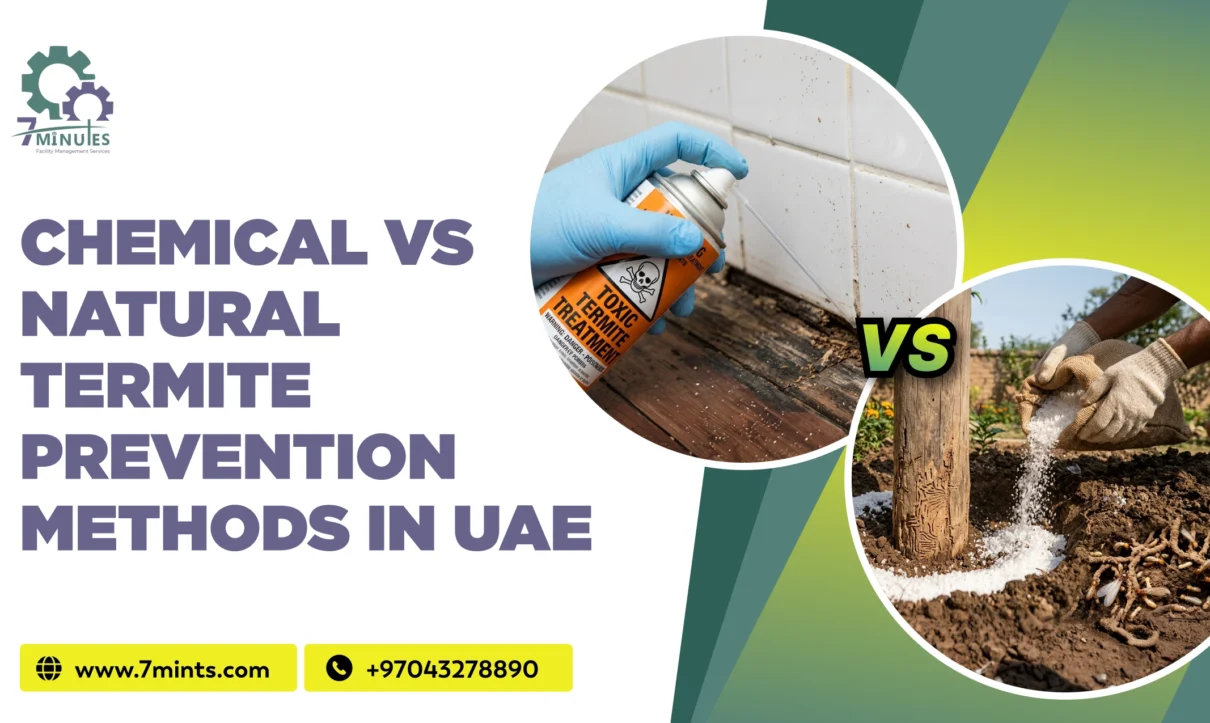
In the UAE, chemical termite treatment is usually the safer bet for strong prevention. Subterranean termites live in the ground, and they spread from there. That means you need a soil barrier or bait to slow them down. Natural options can help, but they tend to work best as extra support. They may also help with small, limited problems.
You notice pencil-thin mud tubes along a villa wall. Then you face a tough decision. Do you use a fast chemical termite treatment, even though it makes you worry about kids and pets? Or do you try a “natural” option that might not actually stop the whole colony?
This guide looks at termite prevention choices in the UAE. The goal is to help you decide without playing a guessing game. A solid plan often mixes both. Use a licensed termite treatment at a low dose. Then add non-chemical steps that cut off the moisture the termites rely on.
What are Chemical and Natural Termite prevention methods?
Chemical termite prevention uses approved termiticides. The aim is to kill termites or block their path. Natural termite prevention relies on things like physical barriers, moisture control, heat, mineral approaches, or plant-based products. Instead of synthetic insecticides, it focuses on reducing access and stress on termite activity.
Termite prevention in the UAE matters for one clear reason. Termites cause around USD 40 billion in damage each year worldwide.
| Group | Examples | How it works |
| Chemical | Soil barrier (fipronil, imidacloprid, bifenthrin), wall injection | Treated soil kills or repels termites |
| Targeted low-chemical | Bait stations, borate wood treatment | A tiny dose is carried to the colony, or wood becomes unappetising |
| Natural / non-chemical | Steel mesh, moisture control, heat, neem or orange oil | Blocks access, removes water, or overheats infested timber |
Why Termite Prevention Matters in the UAE
Key point: The global cost is near USD 40 billion per year. Subterranean termites account for roughly 80%.
In the UAE, the big risk is underground termites. They can enter a villa using thin mud tubes. These tubes form along foundations, inside wall gaps, and around pipe openings. In a dry setting, the colony still needs water to keep going. So it looks for it in places people create. Water from irrigated plants near the building helps. Planters can collect moisture too. Condensate from air-conditioning units adds more. Water around pools and small hidden leaks also matter.
Because of this, termite prevention should start with moisture control. It should not start with a spray. If a treatment does not deal with the water source, it often needs to be redone later.
Check out our latest blog post on How to Make Your Home 100% Termite-Resistant in the United Arab Emirates
Chemical Termite Treatment: What it Does and Where it Helps
Chemical termite treatment involves a registered termiticide. It is applied to soil around and under a building. It can also be added to infested wood. The goal is to kill termites or stop them from entering.
In this region, two chemical approaches are common. Pyrethroids can form a quick barrier and push termites away. Non-repellent neonicotinoids, such as imidacloprid, can be carried by workers. That spread helps the colony collapse. Fipronil is used in a similar way, but it works more slowly. Termites take it back to where the nest is.
Pros of chemical termite treatment
- Chemical treatments can reach deep underground areas that simple home methods usually miss.
- Some non-repellent products kill the whole colony, rather than only stopping movement.
- Many soil barrier plans are sold with claims of protection that last about 5 to 10 years.
Cons of using chemical termite treatment
- Some households worry about chemical contact, especially with kids or pets in the home.
- This is why the re-entry directions after treatment matter a lot.
- Repellent products may only push termites away and do not remove the colony.
- If you have paved or tiled edges, drilling might be needed before treatment.
- Extra water from heavy irrigation can also weaken the soil barrier.
Safety and rules to follow
- Use a licensed termite operator. In the UAE, termite work is tied to specific licensing, not just general pest control.
- Dubai Municipality handles termite control as its own registration type.
- Request the product name, the exact application areas, and a written warranty before work starts.
Natural Termite Prevention Methods: What Works and What Doesn’t
Natural methods can lower the odds of termite activity without synthetic insecticides. In most cases, they work best for prevention or for small, contained issues. They are less reliable for an already established colony.
Natural options, from strongest to weakest
- Moisture control. Fix leaks, move water away from the home, and keep sprinklers off walls.
- Avoid wood contact with soil. This is often the most effective natural step.
- Physical barriers. Use stainless steel mesh and termite-resistant materials.
- These help block entry and are best when installed during construction.
- Timber heat treatment. When the core of the wood gets near 55 to 60°C, termites are harmed. The process also affects eggs and the other life stages. This option works best for furniture and enclosed sections. It is not a good fit for an entire villa.
- Borate treatment for termites. Borates move through moist wood. This lets them get deeper inside the timber where termites feed. It is used for wood protection.
- Using plant oils. Neem oil gets mentioned a lot for small issues. Still, smells such as clove, cedarwood, and cinnamon do not stop a full colony on their own. They may slow activity, but they are not a solid kill method.
Important point. A usual home remedy is not reliable once a subterranean colony is already set up. If you spot live termites, mud tubes, or timber that sounds hollow, call a pest professional. Do not depend on oils alone.
Chemical vs Natural Termite Prevention: Side-by-Side Comparison
Chemical vs. natural prevention. The key gap is how fast and how far the action goes. Chemical products can get to underground colonies faster. Natural approaches tend to reduce risk slowly. They often do not reach the main nest.
| Factor | Chemical | Natural |
| Speed | Soil and injection termite treatment acts within days to weeks; baits take months. | Prevents entry; does not kill an existing colony (heat is the exception) |
| Reaches the colony? | Yes, especially non-repellent products and baits. | Rarely |
| Best for | Active infestations, new builds | Prevention, small or contained problems, chemical-sensitive homes |
| Safety | Approved products, licensed application, re-entry rules | Lower chemical exposure, but weaker results alone |
| Typical termite prevention lifespan | 5-10 years (soil barrier, provider claims) | Depends on upkeep; moisture fixes must be maintained. |
How to Build a Termite Prevention Plan: Step by Step
A strong plan has six parts. First, you check. Then you remove the moisture. After that, you pick a method. Next, you bring in a licensed technician. Then you apply the treatment. Finally, you keep checking.
Step 1: Do an inspection: A pro looks for the termite type and where it is active. They also trace the wet spot that is feeding the problem. For a villa, the check usually takes about two to three hours.
Step 2: Fix moisture around the home: Look for leaks and drips. Repair what you find. Move sprinklers and plants so they do not sit against walls. Also reroute AC water and make sure the condensate has a clear path away from the structure.
Step 3: Pick the right termite prevention method: If the issue is active in soil, use a soil barrier or a termite injection approach. If you need to reduce a colony, use bait systems. For wood and items like furniture, use borate, mesh, or heat treatments.
Step 4: Hire a licensed operator: Before you proceed, verify that the company is registered with the right local authority. In Dubai, that means Dubai Municipality, or the local required body. Also confirm the products are approved for termite work.
Step 5: Apply the termite treatment: Follow the re-entry rules from the operator. Keep the paperwork. Save the product names, the treated areas, and the warranty terms.
Step 6: Monitor at least once a year: Do not treat and then forget it. Book an inspection each year. Also schedule another check soon after the treatment is done.
Example Scenario: Mud tubes by a wet planter area
This is just an example. It is not a real client job.
An owner notices mud tubes on a boundary wall beside a planter that is irrigated. The inspection points to subterranean activity. It also shows the moisture source: a sprinkler head plus a blocked AC drain. The plan is to move the sprinkler and clear the drain, then add a barrier or a bait setup. After that, set up an annual inspection.
Frequently Asked Questions
Q1. Do natural termite controls work in the UAE?
They can help lower the chance of termites moving in. They do not usually wipe out a colony that is already active. Keeping moisture low helps a lot. Steel mesh and borate can also reduce risk. Neem oil or orange oil may help with minor, visible trouble. If termites are already in the ground or inside walls, a licensed termite company is the safer choice.
Q2. Is termite chemical treatment safe for kids and pets?
When a licensed team uses approved termiticides, they follow methods made for home use. Still, you must follow the re-entry time and airflow steps. Request the exact product names first. Get the written safety directions before any work starts.
Q3. How long does termite prevention last?
A soil barrier treatment is often sold as lasting about 5 to 10 years. Bait systems need checks every year. Moisture control keeps working only while you keep up the moisture fixes. Natural steps also need repeat care.
Q4. Can I use neem oil or orange oil on my own?
You can try it for a tiny area you can see. It rarely reaches the full colony. If you notice mud tubes coming back, or if wood makes a hollow sound, treat it as a case for proper termite treatment.
Q5. What is the top termite prevention plan for a new villa?
Before construction, treating the soil is often viewed as the most cost-effective option for new homes. Many people also add moisture control membranes. Steel mesh at entry points is another common step.
Q6. What will termite treatment cost in Dubai?
Prices listed by companies often start near AED 300 for small tasks. Larger villa soil barrier work may reach AED 8,000 or more. Bait systems often cost around AED 2,500 to AED 5,000 to set up. Yearly monitoring is usually extra.
Conclusion
Both chemical and natural termite prevention methods have their own advantages and limitations, and choosing the right one depends on your needs. Chemical methods deliver quick results that last, but they present health dangers and environmental hazards. Natural methods offer safe environmental solutions, yet they demand extra time and work.
The United Arab Emirates sees its best results through a method that combines both existing approaches. The system achieves effective termite control while maintaining safe and environmentally friendly operations. Contact Us as Proper termite prevention measures from today will protect you against future costly repair needs. The best method to protect your home requires you to start safeguarding your property at the earliest opportunity.



1 Comment
Comments are closed.