

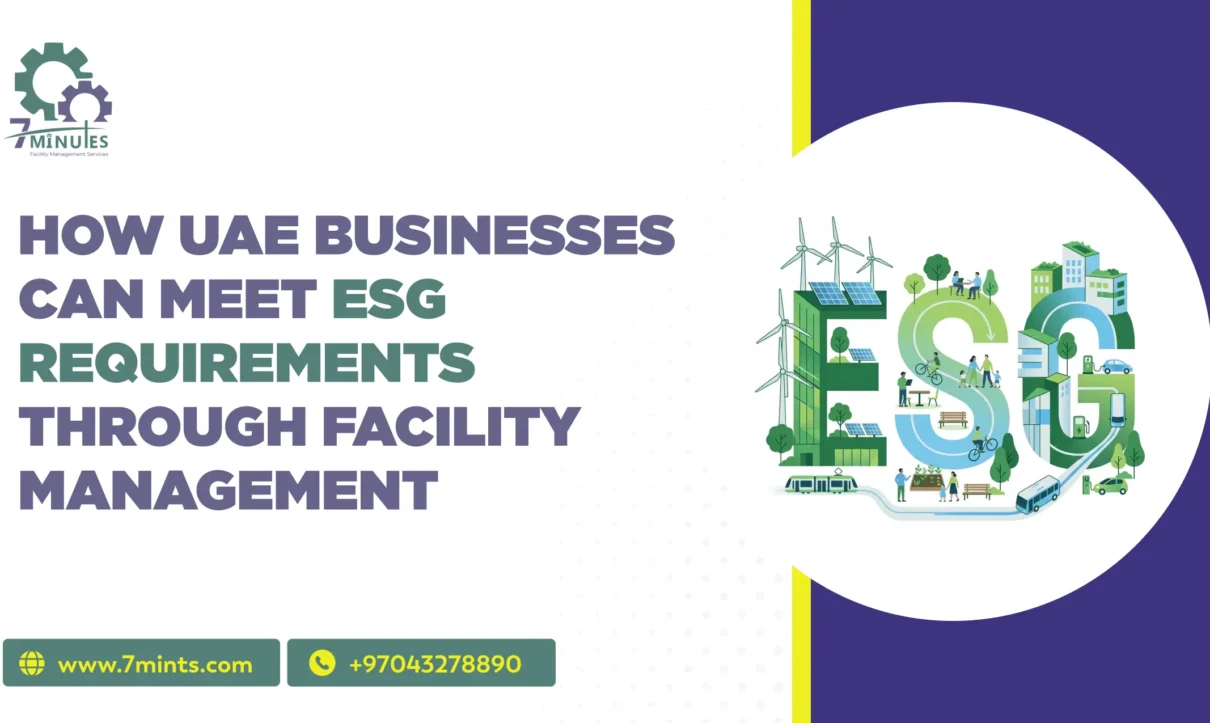
Environmental, Social, and Governance (ESG) has become a key business priority in the UAE. As the nation advances its sustainability agenda through initiatives like the UAE Net Zero 2050 Strategy and green building regulations, businesses are expected to adopt environmentally responsible, socially conscious, and transparent operational practices.
One of the most practical ways to achieve these goals is through facility management (FM). Modern facility management goes beyond maintaining buildings—it plays a strategic role in reducing environmental impact, enhancing employee well-being, ensuring compliance, and improving operational efficiency. By aligning facility management practices with ESG principles, UAE businesses can strengthen their sustainability performance while creating long-term business value.
Why ESG is now a legal reality, not some PR activity
For years, ESG reporting in the UAE was treated more like a “reputation, nice-to-have” kind of thing. But in 2024–2026 that narrative shifted fast, and now the rules are more concrete
- Federal Decree-Law No. 11 of 2024 on the Reduction of Climate Change Effects came into effect on 30 May 2025, and full compliance is required by 30 May 2026. The law covers a wide set of entities, including free zone companies, and it requires greenhouse gas measurement and reporting through the Ministry of Climate Change and Environment’s platform. If you do not comply, penalties can run from AED 50,000 up to AED 2,000,000, and repeat cases can face more severe consequences.
- Listed companies on the Abu Dhabi Securities Exchange (ADX) and Dubai Financial Market (DFM) must submit annual sustainability reports, usually within 90 days of the financial year closing, or before the AGM. These reports need to follow guidance that lines up with the Global Reporting Initiative (GRI), IFRS S1/S2 (ISSB), and TCFD.
- DIFC, via the Dubai Financial Services Authority, basically expects regulated firms to weave ESG factors into governance, risk management, and disclosure.
Why Facility Management sits right at the center of ESG compliance
Most ESG frameworks ask the same sort of three questions. How much are you using? How are you treating people? And how strong is the governance plus verification? For most UAE businesses—retailers, hospitality groups, office owners, logistics operators, and manufacturers—the truthful answers are sitting inside facility operations, not somewhere abstract Energy and water use are metered and managed at the building level
- Waste segregation, recycling rates, and disposal paperwork are facility management duties.
- Indoor air quality, workplace safety, and contractor well-being fall under facility management and hard services teams.
- HVAC systems, generators, and building management systems drive the emissions data required under the Climate Law (Scope 1 direct emissions and Scope 2 from purchased electricity and cooling).
In short, facility management is not some add-on support function sitting outside the ESG conversation—it’s more like the operational layer that actually generates the evidence regulators and auditors will ask for. Companies that treat ESG as a pure reporting exercise, kind of disconnected from facilities management, often end up scrambling at year-end. On the other hand, organizations that build ESG into facility management contracts and daily building operations tend to produce the required data as a natural byproduct of normal work, you know, not as a last-minute scramble.
Environmental Pillar: Where Facility Management Delivers the Most Measurable Impact
1. Energy Management and Building Performance
Cooling, in most UAE buildings, takes up the largest share of energy use, and the major green building codes basically agree with that. Dubai’s Al Sa’fat system weights energy at roughly 43% of its point allocation, which is the highest among comparable rating setups, while Abu Dhabi’s Estidama Pearl Rating System gives energy and water the same level of weight. Facility management teams can shift outcomes by,
- Retro-commissioning HVAC and Building Management Systems (BMS) to close the gap between what was designed and what is actually happening in energy performance (there’s that well-documented “performance gap” in UAE buildings).
- Upgrading to high-efficiency chillers, variable-speed drives, and smart lighting controls.
- Benchmarking energy use per square meter against Al Sa’fat, Estidama, or LEED baselines, even if the building was not originally certified.
2. Water Efficiency
With UAE water scarcity in the background—and the Water Security Strategy 2026 targets halving per-capita consumption—facility management-led measures help in a very direct way. Things like low-flow fixtures, greywater recycling, smart irrigation, and leak detection metering support regulatory alignment and also cut operating costs at the same time.
3. Waste and Circular Economy
Waste segregation at source, contracts with certified recyclers, and material reuse programs (kinda) flow right into the “Materials and Resources” and circular economy expectations that show up in both government ESG guidance and green building codes. So yeah, it is not only “waste” on paper; it actually turns into measurable compliance criteria later.
4. Emissions Data for the Climate Law
Scope 1 (direct, e.g., on-site generators and fuel use) and Scope 2 (indirect, e.g., grid electricity and district cooling) emissions are the same exact categories that facilities teams already watch day to day using utility bills and BMS data. If a business structures facility management reporting to capture this information in an emissions-ready format—instead of sending around raw utility invoices, which is messy—then that is among the highest-leverage steps to take before the climate law compliance deadline.
Social Pillar: The People Side of Facility Operations
The “S” in ESG is frequently viewed as HR-only work, but facilities and soft services operations (security, cleaning, maintenance, and catering) usually employ a big chunk of a company’s on-site workforce, often via contractors. So Facility Management ends up owning a lot of the real-world outcomes, basically because the people are there.
- Occupational health and safety compliance for maintenance, cleaning, and security staff.
- Fair labor practices and wage standards among facility management subcontractors are increasingly scrutinized as supply chain due diligence expectations keep getting sharper.
- Indoor environmental quality (air quality, thermal comfort, lighting, and acoustics) that shapes the well-being of every building occupant, and it is also a scored area under Al Sa’fat and Estidama.
- Community and Emiratization commitments when facility management providers are UAE-based, supporting local employment in practice, not just on slides.
Vetting Facility Management contractors on labor practices, not only on price and service-level agreements, is becoming a governance issue as much as it is a social one, and that distinction matters more each year.
Governance Pillar: Making Facility Management Data Audit-Ready
Governance failures in ESG reporting usually aren’t really about bad intent; they’re more like data quality. A bunch of common trouble spots show up, like utility data being spread across multiple sites, properties, and even different providers; units that never quite match; and then there’s no clear owner of the numbers. So to close that gap, in practice:
- Give clear responsibility for ESG-related facility management data (energy, water, waste, and incidents) to an actual named role, ideally feeding into a sustainability committee or officer, because boards are expecting this more and more.
- Use facility management software or BMS platforms that can export data in formats compatible with GRI, SASB, or ISSB metrics, instead of doing the spreadsheet reconciliation routine manually every year.
- Maintain a real, written audit trail: meter readings, maintenance logs, and contractor certifications should be retrievable, not rebuilt after the fact just to “make it fit.”
A Practical Roadmap for UAE Businesses
- First, map your obligations. Work out which regime applies to you—Climate Law emissions reporting (generally applicable), ADX/DFacility Management listing rules, ADGM/DIFC thresholds, or none directly (and even then, client and lender expectations can still show up).
- Then audit your current facility management data. Get clear on what energy, water, waste, and safety information your facility management operations are already collecting and where the holes actually are.
- Next, align facility management contracts to ESG metrics. Build energy benchmarks, waste diversion goals, and labor standard clauses into service level agreements with your facility management providers.
- Invest in metering and BMS upgrades. You cannot report what you cannot measure; sub-metering by zone or system pays back in both energy savings and reporting accuracy.
- Pursue green building recognition where it makes sense. Even for existing buildings, benchmarking against Al Sa’fat or Estidama criteria gives a kind of credible signal on performance to tenants, lenders, and regulators.
- Centralize reporting. Bring facility management data into one ESG reporting framework (GRI, ISSB, or a sector-specific option) rather than ending up with separate, disconnected reports for each regulator.
Also, get independent verification for emissions and key utility numbers before your first regulatory filing. Do it before, not after, a compliance query, because that tends to be more painful.
Conclusion
In the UAE, ESG has shifted from a “nice-to-have” story into something more regulated, penalty-backed, and real. And the everyday truth is that the way you run facilities becomes a core pathway for meeting ESG expectations. If a business keeps sustainability reporting and building operations in separate little silos, compliance tends to become harder, and yes, more expensive than it really has to be. On the other hand, treating Facility Management as the engine room of ESG—where metering, contracts, and data governance work together Contact us as ETS businesses meet their regulatory duties almost as a byproduct of properly managed buildings, not as a last-minute sprint before a filing deadline.
Frequently Asked Questions
Q1 Is ESG reporting mandatory for all businesses in the UAE?
Not universally, but the scope is moving fast. Listed companies on ADX and DFacility Management are already subject to mandatory sustainability reporting duties. The climate law adds another broader obligation around emissions measurement and reporting.
Q2 What does facility management have to do with ESG compliance?
Facility management runs the systems—HVAC, metering, waste handling, and on-site labor—that create the environmental and social data the ESG frameworks need. Aligning facility management contracts, building systems, and data routines with reporting standards is usually the most straightforward path toward accurate, audit-ready ESG disclosures.
Q3 Which green building standards apply in the UAE?
Abu Dhabi uses the Estidama Pearl Rating System. At a minimum, it’s mandatory to have one Pearl level for new buildings (and two Pearls for government-funded projects). Dubai uses the Al Sa’fat Green Building System, which is mandatory at a minimum silver level for new developments. Both systems weigh energy performance heavily, which fits the UAE’s cooling-heavy energy reality.
Q4 What if a business doesn’t comply with the Climate Law’s emissions reporting requirements?
Penalties can run from AED 50,000 up to AED 2,000,000, with tougher consequences for repeat breaches, and if the case is serious enough, non-compliance can also end up touching the business licensing side of things.
Q5 Do small and mid-sized businesses need to be concerned about ESG, or is it mainly a large, listed company issue?
Even though the sharpest mandatory reporting duties right now land on listed and bigger entities, the pressure is basically traveling through the supply chain. In practice, multinational clients, banks that provide green financing, and government procurement rules are increasingly asking vendors to show credible ESG information, even when those vendors are not publicly listed.


1 Comment
Comments are closed.