

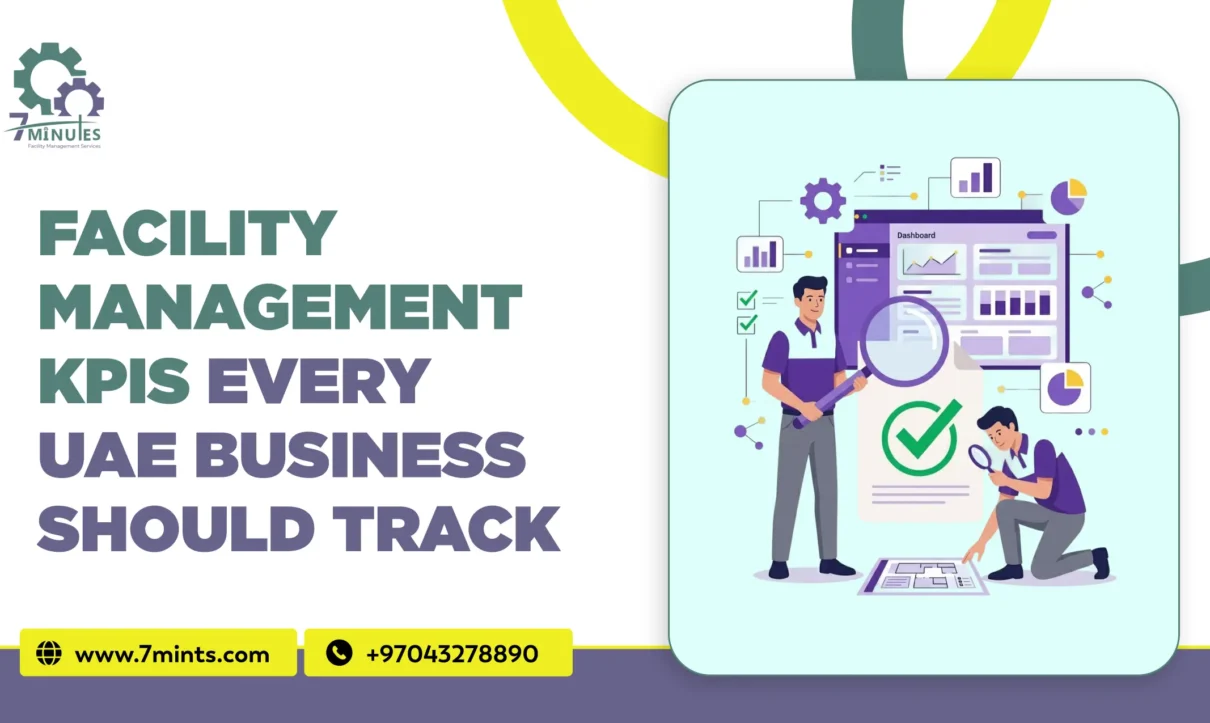
Facility management KPIs are numbers you can measure, like maintenance response time, how often preventive jobs finish on schedule, energy use efficiency, and tenant or occupant satisfaction. UAE companies use these to watch rising utility and repair spend, meet safety rules, and meet ESG reporting needs. They also help spot equipment problems before they lead to downtime. Without KPIs, decisions lean on assumptions, not on results.
Each month in Dubai and Abu Dhabi, facility groups receive work orders, utility bills, and maintenance notes. Then they review the same reports once. After that, they sit in folders. The outcome is predictable. HVAC breaks in August even though servicing was skipped in June. Costs drift past the plan. When leaders ask if the building is truly doing well, nobody can answer with proof. This is the issue the article points to. It is not a data shortage. It is the lack of the right KPIs to turn that data into action.
What Facility Management KPIs Mean
Facility management KPIs are set as measurable indicators. They show how a building and its systems are doing and how the maintenance team performs relative to clear operating goals. They often fall into five themes: maintenance performance, energy and utilities, the occupant experience, cost control, and safety compliance.
A basic metric is not the same as a KPI. For example, “42 work orders were logged this month” is just activity. A KPI links the activity to a goal and an outcome. It might be “90% of work orders close within the SLA.” That difference matters. Activity tells you what was recorded. A KPI tells you if the result meets the target. For UAE facility teams running commercial towers, malls, hospitals, and mixed-use developments, that difference is what separates reactive firefighting from planned, budgeted operations.
Why Facility Management KPIs Matter for UAE Businesses
Facility management KPIs are important because they turn building data into savings, rule checks, and stable operations. Those three things can affect a UAE company’s spending and legal risk.
There is also market pressure here. One industry review puts the UAE facility management market at about USD 6.83 billion in 2024. It expects growth to around USD 12.33 billion by 2033. It cites a CAGR of 6.9% due to more construction and faster smart-building use in Abu Dhabi and Dubai. With that kind of growth, facility teams get more scrutiny. They have to show results with figures, not guesses.
4 Reasons KPI tracking matters for UAE businesses
1) Control costs during very hot weather: Cooling is needed for most of the year. That makes energy and maintenance measures the biggest tool for managing daily costs.
2) Meet rules and keep people safe: UAE labor rules and local municipality requirements expect safety and upkeep to be recorded. KPIs help build the audit trail.
3) Decide faster when the business is moving quickly: In areas like hospitality, healthcare, and commercial real estate, leaders often need clear performance reports. They need data to back budget calls, not just opinions.
4) Reduce sudden equipment failures: With preventive maintenance KPIs, teams can spot problems in HVAC, electrical, and plumbing earlier. Fixes done on schedule usually cost far less than emergency work. Emergency repairs often run about 3 to 5 times more than planned tasks.
Facility Management KPIs Every UAE Business Should Track
For most UAE firms, the best facility management KPIs usually fit five groups. Maintenance, energy, occupant experience, cost, and safety come up most often. Below are ten to start with.
1. Maintenance Response Time
Maintenance response time shows the delay between logging a problem and when the team first responds and starts fixing it. When that number is low, it usually means the site is staffed right and processes work. Tenants and staff notice, and they tend to feel better about the service.
In the UAE, many firms keep running all day and into the evening across multiple places. Offices, shops, and hotels all face the same issue. If an AC stops or a pipe leaks and no one acts fast, work slows down. In guest-focused areas, it can also hurt how visitors feel.
2. Preventive Maintenance Completion Rate
This KPI looks at how many planned tasks get finished on time. It compares completed work to all scheduled work. Many teams aim for about 85% to 95%. When this rate starts to slip, it often shows up before equipment starts failing more often.
UAE HVAC and electrical gear has to handle heat that lasts for weeks. So you cannot skip preventive work. When technicians service chillers, pumps, and cooling towers on a steady schedule, they run better during the hottest stretch. This is even more important when spare parts take time to ship.
3. Energy Use Efficiency
This metric looks at energy use per building area. You will often see it as power and water per square foot, or a similar measure tied to floor size or how the building is used. When the numbers run high, it can mean the system is wasting energy. Common causes include oversized cooling, poor insulation, and older lighting.
In many UAE buildings, cooling is a major part of the utility bill. Teams usually begin with simple steps, like adding smart thermostats. Switching to LED lighting can help as well. A building management system, or BMS, also lets staff set times and controls more closely so the equipment does not run when it should not.
4. Equipment Downtime (Asset Uptime)
Equipment downtime is the total time key systems are not working. This includes HVAC units, lifts, backup power, and fire protection. When downtime is low, fewer services get disrupted. That can also cut the need for costly urgent fixes.
In the UAE, this matters in areas like healthcare, logistics, and hotels. These places keep running day and night. Downtime records let site teams plan work ahead of time. They can spot repeat failure cycles. Then they act before things break down again, not only after complaints start.
5. Occupant satisfaction score
The occupant satisfaction score shows how people judge life inside a building. Staff, tenants, and customers can be asked. Most teams use a survey every quarter. They ask about cleanliness, air quality, comfort, and how fast help is given. Many targets aim for a result above 4 on a 5-point scale.
UAE companies are also fighting for talent and for tenants. Because of that, the way people feel inside the building is tied to keeping them. It is not only about comfort anymore. When ratings are weak, staff changes rise. Vacancies can follow.
6. Space use Rate
Space utilization rate tells how much of the available floor area is used during work hours. It points out rooms that sit empty, like offices, meeting spaces, or retail layouts. If areas are underused, the facility can lose money. The space may not add real value.
Hybrid work is common across many UAE firms. So this KPI is now used more often in real estate talks. Teams try to size offices based on how many desks are actually filled. They compare real use to what was planned, not just booked.
7. Facility Operating cost per square foot
This KPI splits overall operating spend by the total floor area being managed. Operating spend includes upkeep, utilities, cleaning, and security. Finance teams use this one figure to compare a building in one year to another building in a different year.
In Dubai and Abu Dhabi, commercial towers and malls are large. Because of that, a small gain per square foot can add up fast. It can lead to a big saving across the whole site.
8. Safety Incident Rate
This KPI tracks work injuries that are recordable. It also includes near misses and breaks of safety rules. Results are often shown as incidents per 100 workers. The goal is to see if safety steps are doing real work, not only existing on paper.
In the UAE, labor rules and city guidance ask companies to run safety checks across many kinds of sites. If the number rises, teams should respond fast. They can start by revisiting drills, staff instruction, and the way teams manage emergency situations. If a company ignores the change, it may face legal issues and negative reactions from the public.
9. SLA Compliance Rate
SLA compliance rate is the share of tasks that meet the agreed service times. It covers both vendors and in-house teams. In many UAE facilities, outside contractors handle a lot of the work, so this measure tends to matter most in contracts.
For the facility owner, it is a clear set of facts. It supports follow-ups with FM providers when deadlines are missed. When a service deal is reviewed again, this rate is often the first figure people discuss.
10. Facility Condition Index (FCI)
FCI compares money that is delayed for upkeep with the full cost to replace the building. As a rule of thumb, a score under 0.10 is seen as healthy. A value over 0.30 points to a site that likely needs large capital work.
For UAE owners who plan upgrades or add more assets, FCI turns a vague concern into a solid planning figure. It helps justify budget choices with a number, not only with feelings.
Facility Management KPI Comparison Table
| KPI | Category | Good UAE Benchmark |
| Maintenance Response Time | Maintenance | Under 4 hours (critical systems) |
| Preventive Maintenance Completion Rate | Maintenance | 85–95% |
| Energy Consumption Efficiency | Sustainability | Year-over-year reduction |
| Equipment Downtime | Maintenance | Trending downward |
| Occupant Satisfaction Score | Experience | Above 4.0 / 5.0 |
| Space Utilization Rate | Space | 60–80% |
| Operating Cost per Sq Ft | Financial | Benchmarked vs. peers |
| Safety Incident Rate | Safety | Below industry average |
| SLA Compliance Rate | Vendor Management | 95%+ for critical services |
| Facility Condition Index | Asset Management | Below 0.10 |
A small case study: KPIs at work
Example. A mid-size retail site in Dubai had maintenance requests, but no real measurement. The staff picked three facility metrics: how fast they respond, how often preventive work gets finished, and energy use per square foot. Soon they saw a clear pattern. About 40% of labeled emergencies were actually failures that could have been avoided. The equipment had missed its last two planned service rounds. Once the preventive plan was adjusted, emergency calls dropped in the next two quarters. Management also got a simple monthly update that showed who was handling what. The point is this. You do not need ten KPIs from day one. Start with three, track them, and people will change what they do.
How to begin tracking facility management KPIs
Making a KPI setup is not a quick task. It is a step-by-step process. Most UAE facility teams follow a similar path:
1) Choose 3 to 5 KPIs that hit your main cost or your main risk. Do not begin with all ten. If energy costs drive your budget, start with energy. If safety is the biggest worry, start with safety.
2) Set a baseline before you set a target. Look at the last 3 to 6 months of maintenance and utility records. You need the current level first; then you can aim to improve it.
3) Give each KPI a clear owner. If no one owns a number, nothing gets fixed. Assign a specific person. Use a name, not just a team label.
4) Pick a tool that fits your size. For one building, a spreadsheet can work. For multiple sites, a CMMS or IWMS system is often a better fit.
5) Review results on a steady schedule. Maintenance items like response time and downtime should be checked weekly. Cost and strategy items like cost per square foot and FCI should be checked monthly or every quarter.
6) Focus on the trend, not only the latest value. One value does not tell the whole story. A steady improvement over time matters more than a single snapshot.
Facility Management KPI Tools and Typical UAE Costs
| Tool Type | Best For | Typical UAE Cost Range | Key Advantage |
| Spreadsheet (Excel/Sheets) | Single building, small teams | Free—low cost | Fast to set up, no vendor lock-in |
| CMMS software | Maintenance-heavy operations | AED 1,000–5,000/month | Automated work order + PM tracking |
| IWMS platform | Multi-site portfolios | AED 5,000–20,000+/month | Integrated maintenance, space, and finance data |
| Outsourced FM provider reporting | Businesses without an in-house FM team | Bundled into an FM service contract | KPI tracking included as part of the service |
Facility Management KPI FAQs
Q1. What do facility management KPIs mean?
They are measurable stats. Examples include how quickly maintenance responds, how much energy is used, and how many safety incidents occur. When you look at these values, you can see if the building team is meeting its targets.
Q2. Which KPI should a business in the UAE begin with?
A lot of UAE teams start with two KPIs. First is how much of the planned preventive work is done on time. Second is how efficiently energy is consumed. These areas often drive the highest costs. When both improve, there are fewer surprise repairs and lower utility bills.
Q3. How frequently should KPIs be reviewed?
For daily work, teams check figures such as response time and downtime each week. For items tied to budgets and planning, like cost per square foot and the Facility Condition Index, most teams review them monthly or about once every three months.
Q4. Do small UAE businesses need these KPIs?
Yes. Even one site can gain from tracking about three to five key KPIs. The point is to spot cost leaks and safety risks early. That matters for any size of operation.
Q5. What is the difference between a facility metric and a facility management KPI?
A metric is just the fact, like “12 work orders completed this week.” A KPI connects that fact to a target and a goal, such as “90% of work orders are closed within the SLA.” That connection is what makes it useful.
Conclusion
The facility management KPIs function as vital tools for companies that aim to boost their operational productivity while decreasing expenses and preserving secure work environments. The metrics, which include maintenance response time, energy efficiency, equipment downtime, and occupant satisfaction, deliver essential information about how a facility operates. Contact Us as the indicators assist organizations in making educated choices while they enhance their operational efficiency, which leads to better building performance.
UAE industries will require more KPI-based facility management systems as they expand their operations and embrace intelligent technology solutions. The companies that maintain continuous measurement of their facility performance indicators will experience increased productivity, enhanced sustainability, and sustained operational excellence. The proper management of facilities enhances everyday business functions while it helps enterprises expand their presence in the competitive UAE marketplace.

2 Comments
Comments are closed.